


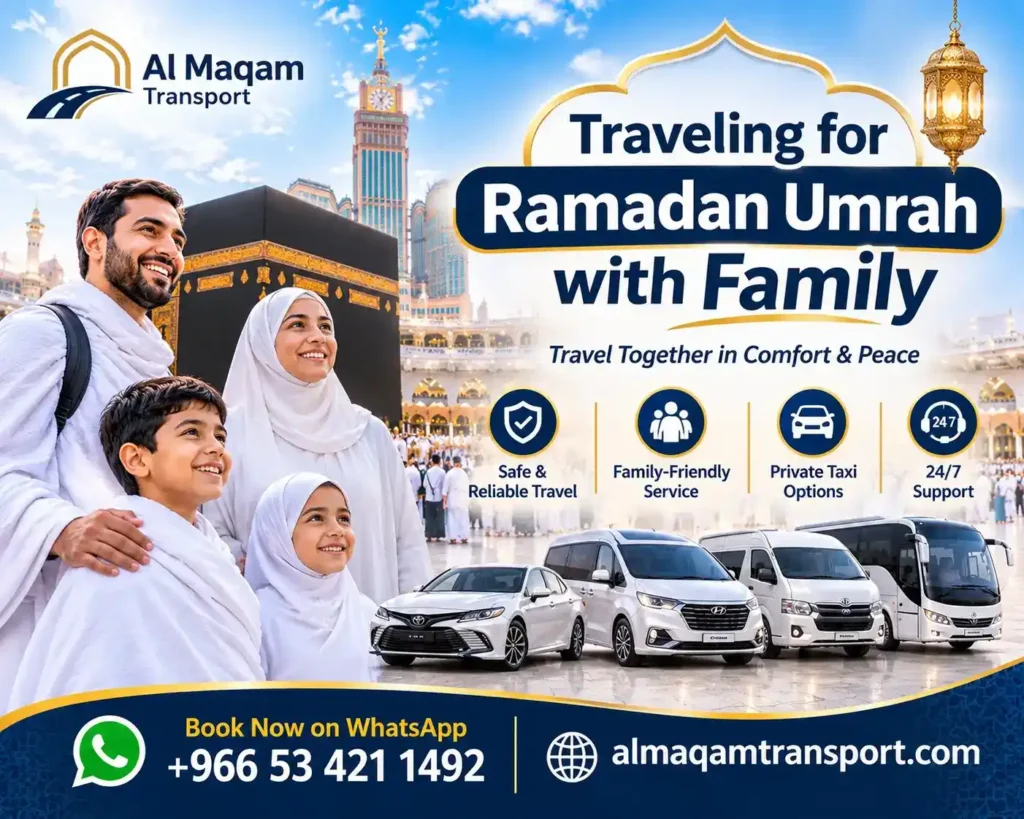
Performing Umrah during Ramadan is a meaningful experience for Muslim families. Praying at Masjid al-Haram, seeing the Holy Kaaba, and spending time in the sacred cities of Makkah and Madinah can create memories that last a lifetime.
However, traveling for Ramadan Umrah with family requires more preparation than traveling alone.
Parents may be carrying luggage and looking after young children. Elderly family members may need frequent rest breaks. Some travelers will be fasting, while others may be adjusting to a long international flight. At the same time, roads, public transportation, hotels, and areas surrounding the Holy Mosques become busier during Ramadan.
Choosing suitable transportation is therefore an important part of planning a comfortable pilgrimage.
Public buses offer affordable transport and serve thousands of pilgrims. However, a private Umrah taxi or family van provides something particularly valuable for families: more control over the journey.
With a pre-booked private vehicle, your family can travel together, choose suitable departure times, and arrange transport between airports, hotels, and cities without following a shared group timetable.
This guide explains how family Umrah transport during Ramadan works, why private transfers often suit families better than public buses, and how to plan your journey through Saudi Arabia.
Why Family Transportation Matters During Ramadan
Ramadan changes the rhythm of daily life in Makkah and Madinah.
Pilgrims organize their days around prayer, fasting, Iftar, Suhoor, and Umrah rituals. Many people prefer visiting Masjid al-Haram during the evening or night, making certain periods particularly busy.
For a family, managing transportation during these hours can be challenging.
Consider arriving at King Abdulaziz International Airport in Jeddah with two children, elderly parents, several suitcases, and a stroller.
After immigration and baggage collection, the family still needs to reach its hotel in Makkah.
Using shared transportation may involve finding the correct bus stop, waiting for departure, managing luggage, and arranging another transfer if the bus does not stop near the hotel.
A pre-booked private transfer can simplify these steps by taking the family from an agreed airport pickup location to its accommodation.
Challenges of Traveling With Children
Young children do not always follow adult travel schedules.
They may become tired after a flight, need a bathroom break, or want something to eat. Families also often carry additional items such as strollers, baby bags, and child restraints.
These requirements can make fixed transportation schedules inconvenient.
A private vehicle allows parents to request suitable stops and keep their belongings together throughout the journey.
For families with infants or toddlers, it is especially important to confirm that an appropriate child restraint can be accommodated before booking.
Transportation Needs of Elderly Pilgrims
Elderly relatives may need additional consideration during Ramadan Umrah.
Long walks between transport terminals, repeated boarding, crowded waiting areas, and extended journeys without suitable rest breaks can make travel uncomfortable.
Some elderly pilgrims may use walking aids or wheelchairs.
For these families, the objective is not simply reaching the destination quickly. It is arranging transportation that respects each passenger’s mobility, comfort, and personal needs.
A suitable private vehicle can reduce unnecessary transfers and provide an agreed pickup arrangement.
Families requiring wheelchair-accessible transportation should specifically confirm vehicle accessibility rather than assuming every private van is suitable.
Private Transport vs Public Buses for Ramadan Umrah
Both private transportation and public buses have advantages.
Public buses are valuable for affordable travel, particularly for individuals and organized groups following a common schedule.
Private transfers generally provide greater flexibility, privacy, and convenience for smaller families.
The best choice depends on the number of travelers, luggage requirements, mobility needs, budget, and itinerary.
Private Taxi vs Public Bus: Family Travel Comparison
| Travel Consideration | Private Umrah Transport | Public Bus |
|---|---|---|
| Departure time | Arranged around your booking | Follows the service timetable |
| Passengers | Your family or reserved group | Shared with other passengers |
| Airport pickup | Agreed collection point | Designated bus station or stop |
| Hotel drop-off | Hotel or nearest permitted vehicle-access point | Depends on route and stops |
| Luggage | Space allocated to your group | Subject to available capacity and rules |
| Family privacy | Private passenger space | Shared passenger space |
| Rest breaks | Can be planned with the operator | Determined by the service |
| Children and elderly relatives | Vehicle selected for family needs | Less individual flexibility |
| Pricing | Usually quoted per vehicle | Usually charged per passenger |
| Best suited for | Families wanting flexible arrangements | Budget travelers and organized groups |
The difference becomes more important when a journey includes multiple family members with different needs.
For example, a family traveling between Makkah and Madinah may prefer to leave after breakfast or after a suitable rest period.
A private transfer lets them request that schedule, subject to availability and road conditions.
A shared bus requires travelers to plan around its published departure times.
When Public Buses Are the Better Choice
Private transportation is not automatically the best option for everyone.
Public buses can be a practical choice for solo travelers, couples with limited luggage, and families staying close to convenient bus routes.
They can also be cost-effective for large organized pilgrimage groups.
The Haramain High-Speed Railway is another excellent option for suitable journeys between Jeddah, Makkah, and Madinah.
For families comfortable with station transfers, train travel may offer a faster intercity journey than road transportation.
The most useful approach is to compare the complete trip, not just the ticket price or time spent inside the vehicle.
7 Reasons Private Transport Works Better for Many Ramadan Umrah Families
1. Comfortable Air-Conditioned Travel
Saudi Arabia can experience warm weather, depending on the season and time of day.
Even during cooler months, spending long periods outdoors while carrying luggage can be tiring.
A private air-conditioned vehicle offers a controlled environment where family members can sit comfortably between destinations.
Al Maqam Transport offers air-conditioned sedans, SUVs, vans, and larger vehicles for pilgrimage transfers.
This is particularly helpful when traveling with children, elderly relatives, or passengers who need additional comfort.
2. Convenient Airport-to-Hotel Transportation
After a long international journey, families usually want to reach their accommodation without unnecessary complications.
Private airport transportation can provide a straightforward journey from the agreed collection point at Jeddah Airport to a hotel in Makkah.
There is no need to coordinate the family’s luggage with an additional shared connection when a direct road transfer is available.
The same advantage applies when arriving at Prince Mohammad Bin Abdulaziz International Airport in Madinah.
Airport pickups should be arranged using the flight number, arrival terminal, passenger details, and an agreed meeting location.
3. Flexible Departure Times Around Fasting
During Ramadan, departure timing deserves special attention.
A family may prefer to travel after Suhoor, during a quieter part of the day, or after breaking the fast.
Others may choose a time that allows elderly family members to rest before a long intercity journey.
With private transportation, families can discuss their preferred pickup time directly with the operator.
However, flexibility does not remove traffic congestion or access restrictions.
Travelers should allow extra time around major prayer periods, especially during the final ten nights of Ramadan.
4. Fewer Transfers With Children and Luggage
Moving several suitcases from one vehicle to another can be inconvenient.
Add a stroller, hand luggage, and young children, and even a relatively short transfer becomes more demanding.
A private vehicle can keep the passengers and their luggage together from pickup to drop-off.
This is particularly useful for journeys between a hotel in Makkah and accommodation in Madinah.
Reducing unnecessary transfers can help parents concentrate on their children rather than continuously organizing bags.
5. More Comfortable Travel for Elderly Family Members
A private transfer can be planned around the mobility needs of older passengers.
Families can request a vehicle with convenient boarding, enough legroom, and space for walking aids.
On longer journeys, suitable rest stops can be discussed in advance.
These arrangements help families avoid unnecessary boarding changes and lengthy walks through transport terminals.
If a family member uses a wheelchair, the operator must confirm whether an appropriately accessible vehicle is available.
6. Family Privacy Throughout the Journey
Ramadan Umrah is often a multigenerational experience.
Parents, grandparents, and children may spend several hours traveling together between the Holy Cities.
A private vehicle gives the family a dedicated passenger area.
Children can rest, family members can talk quietly, and travelers can organize personal belongings without sharing the vehicle with unrelated passengers.
For many families, this additional privacy is a significant benefit.
7. Flexible Ziyarat and Additional Stops
Some pilgrims want to visit important Islamic historical sites during their stay.
In Makkah, these may include Jabal al-Nour, the area associated with the Cave of Hira, and historical locations around Mina and Arafat.
In Madinah, families often plan visits to Masjid Quba, Masjid al-Qiblatain, and the area around Mount Uhud.
Private Ziyarat transportation allows families to arrange a route according to the agreed itinerary.
This may be more convenient for elderly passengers or families who prefer shorter visits and additional rest periods.
Ziyarat travel should be planned separately from the essential rituals of Umrah, and access to individual locations may vary.
Best Transportation Routes for Families Performing Ramadan Umrah
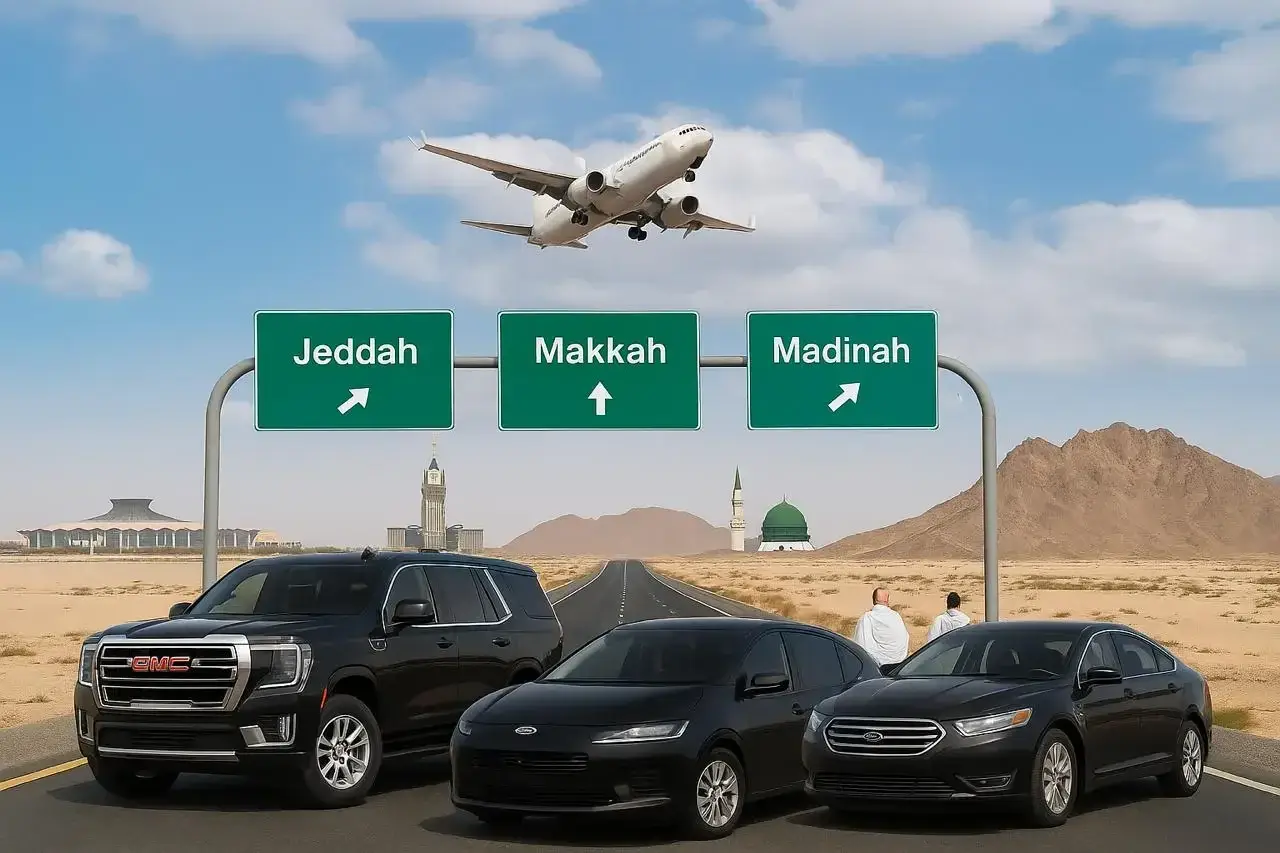
Most international Umrah travelers use a combination of airport transfers, intercity transportation, and local hotel transfers.
Planning these journeys before arrival can reduce confusion during Ramadan.
Jeddah Airport to Makkah: Starting Your Family Umrah
King Abdulaziz International Airport, commonly known as Jeddah Airport or JED, is one of the main entry points for international Umrah pilgrims.
The airport is roughly 80–110 kilometers from many destinations in Makkah, depending on the terminal, route, and hotel location.
A road transfer commonly takes approximately 1–2 hours in ordinary conditions. Additional time may be needed for traffic, Ramadan restrictions, or hotels close to the central area.
For families, a pre-booked Jeddah to Makkah taxi can provide a direct journey to their accommodation or the nearest permitted vehicle-access point.
Before leaving the airport, confirm that every passenger and all luggage are safely accommodated.
Families planning to perform Umrah immediately after arrival should also prepare for the relevant Ihram and Miqat requirements before beginning their journey.
Makkah to Madinah: Traveling Between the Holy Cities
Makkah and Madinah are approximately 420–450 kilometers apart by road, depending on the route and exact locations.
A private road journey typically takes around 4–6 hours, although traffic, rest stops, and road conditions can extend the travel time.
This is one of the journeys where private transportation can be especially helpful.
Imagine traveling with two elderly relatives and three children.
A shared bus departure might require everyone to reach a terminal at a fixed time and manage their belongings before boarding.
With a private Makkah to Madinah taxi, the family can arrange collection from its hotel or another suitable pickup point.
They can also discuss reasonable rest stops before departure.
For families prioritizing speed, the Haramain train is worth comparing. Remember to include the time needed to reach and leave the railway stations.
Madinah Airport to Hotel Transportation
Some families begin their pilgrimage in Madinah.
Prince Mohammad Bin Abdulaziz International Airport (MED) serves travelers arriving in the city.
Private airport transportation can take a family to its hotel near Masjid an-Nabawi or another accommodation area.
This arrangement can be convenient after a long flight, especially if the family is carrying several bags.
Families should confirm the exact hotel entrance and the nearest permissible stopping location.
Road restrictions around the Prophet’s Mosque can affect vehicle access at busy times.
Makkah and Madinah Ziyarat Transportation
For families planning historical and religious sightseeing, private transport can provide a flexible way to visit several locations.
In Madinah, popular destinations include Masjid Quba, Masjid al-Qiblatain, and Mount Uhud.
A Madinah Ziyarat taxi can be arranged around the family’s preferred visiting schedule.
Families can similarly organize private Makkah Ziyarat transportation.
When traveling with children or older relatives, a short itinerary with sufficient rest may be more enjoyable than attempting to visit every destination in one day.
Choosing the Right Vehicle for Family Umrah Transport During Ramadan
Choosing a vehicle is about more than counting passengers.
Every family has different requirements.
A group of four adults traveling with hand luggage may fit comfortably in a standard car.
The same group with large suitcases, a stroller, and a wheelchair may need a larger vehicle.
Al Maqam Transport offers several vehicle categories for different journey types.
Toyota Camry: Couples and Small Families
A Toyota Camry can be suitable for couples or small families traveling with limited luggage.
It is a practical option for airport transfers and intercity travel where the passenger and baggage requirements fit the vehicle.
Families should confirm usable luggage space and child-restraint arrangements before reserving a sedan.
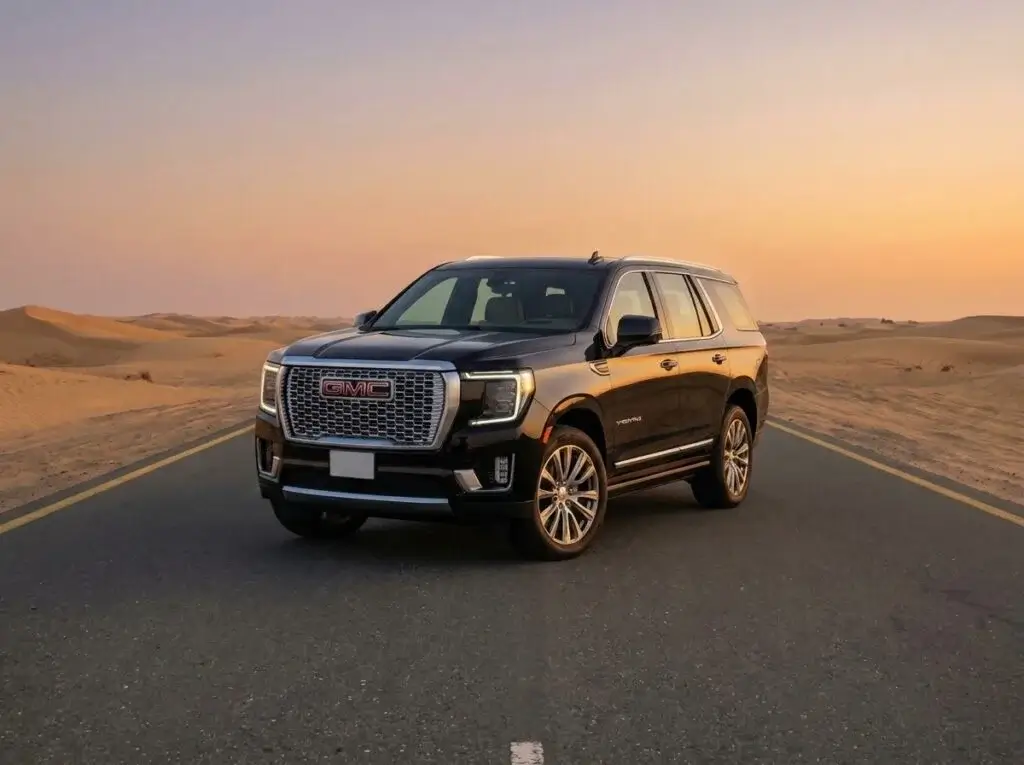
GMC Yukon: Families Wanting an SUV
A GMC Yukon offers a larger SUV-style travel experience.
It may suit families seeking additional passenger comfort and storage space.
However, higher vehicle steps may not suit every elderly passenger.
Families should consider ease of boarding as well as cabin size.
Hyundai Staria: Families With Children and Luggage
The Hyundai Staria is worth considering for medium-sized family groups.
Its spacious passenger configuration can make it useful when travelers have children, suitcases, and additional belongings.
Actual seating and luggage capacity depend on the vehicle configuration, so both should be confirmed during booking.
Toyota Hiace: Extended Families
A Toyota Hiace can accommodate larger family groups when the available configuration meets the passenger requirements.
It may be suitable for extended families traveling together between Jeddah, Makkah, and Madinah.
Keeping everyone in one vehicle can simplify coordination, particularly when family members are arriving together.
Toyota Coaster: Larger Pilgrimage Groups
A Coaster bus can be suitable for larger family groups or organized pilgrimage parties.
A privately reserved Coaster offers group transportation without necessarily sharing the vehicle with unrelated travelers.
Because larger vehicles have different access and parking requirements, pickup and drop-off arrangements should be confirmed carefully.
How to Select Your Vehicle
Before booking, count every passenger, including children.
Then consider the number and size of suitcases, strollers, mobility aids, and any other bulky items.
Confirm that the vehicle provides appropriate seats and seat belts for all passengers.
If child seats or specialist accessibility equipment are needed, request confirmation of availability before paying or finalizing the booking.
A suitable vehicle should provide safe seating and practical luggage storage, not simply the maximum number of advertised passenger seats.
How Much Does Private Ramadan Family Transport Cost?
The cost of family transportation during Ramadan depends on several factors.
There is no single fare that applies to every group and every route.
The main pricing considerations include the distance, travel date, vehicle category, passenger requirements, luggage, pickup location, destination, and any special stops.
Availability during busy Ramadan periods can also affect the choice of vehicle.
Private Taxi vs Public Bus: Compare the Total Cost
Public transportation often costs less per passenger.
Private transportation usually has a higher total vehicle price, although that cost is shared by the family.
For example, consider a hypothetical family of six.
If a shared transport option costs SAR 75 per passenger, the total ticket cost would be SAR 450.
If the family receives a private vehicle quotation of SAR 500 for the same journey, the difference would be SAR 50 for the entire group.
These are illustrative figures, not current fares or an Al Maqam Transport quotation.
The family should also consider whether reaching the bus station or traveling from the destination station to the hotel requires additional transport.
When comparing options, calculate:
Total shared transport cost = Passenger tickets + station transfers + applicable luggage charges.
Total private transport cost = Confirmed vehicle quotation + any agreed extras.
This comparison is more useful than comparing a single bus ticket with the price of an entire private vehicle.
Why Advance Booking Matters During Ramadan
Demand for suitable family vehicles can increase during Ramadan, especially around the final ten nights.
Booking early gives families more opportunity to select an appropriate vehicle and discuss their requirements.
Al Maqam Transport provides advance fare quotations for its private transportation services.
Ask the booking team to confirm the total price, pickup details, and any additional charges in writing.
Do not assume that every route, waiting period, or optional stop is included unless it appears in the booking confirmation.
How to Book Private Family Umrah Transport
Arranging private Umrah transportation is easier when you have your journey information ready.
Al Maqam Transport accepts booking inquiries through its website and WhatsApp.
Step 1: Share Your Route
Tell the booking team where your family needs to travel.
For example:
Jeddah Airport to a hotel in Makkah, followed by Makkah to Madinah several days later.
If you need an airport return transfer or Ziyarat transportation, include those journeys in your inquiry.
Step 2: Provide Your Travel Details
Share the intended pickup date and time, flight number if applicable, pickup address, destination hotel, passenger count, and luggage requirements.
Mention the ages of children who require child restraints.
If someone needs boarding assistance or wheelchair-accessible transport, explain the specific requirement.
Step 3: Confirm the Vehicle and Fare
Before finalizing, confirm the vehicle category, passenger capacity, luggage capacity, total price, and pickup arrangement.
Ask about waiting time, flight delays, cancellation terms, and additional stops.
Receiving these details in writing helps avoid misunderstandings.
Step 4: Save Your Pickup Information
Keep the booking confirmation and contact number accessible.
For airport transfers, confirm the arrival terminal and meeting point.
For hotel transfers, ask whether the driver can reach the hotel’s entrance or whether a nearby pickup location is required.
Step 5: Reconfirm Before Travel
If your flight, hotel, or itinerary changes, notify the transport provider as early as possible.
Reconfirming the journey shortly before departure helps ensure that the pickup details remain correct.
Practical Ramadan Umrah Travel Tips for Families
Plan Around Iftar and Suhoor
Travel during Ramadan requires additional timing considerations.
A family may want to avoid beginning a long journey immediately before Iftar unless appropriate arrangements have been made.
Keep necessary food and water available for family members who are not fasting and for breaking the fast when appropriate.
When planning an intercity journey, discuss a suitable rest stop with the driver in advance.
Allow Extra Time During the Last Ten Nights
The last ten nights of Ramadan are especially important to many pilgrims.
They can also bring heavier crowds around the Holy Mosques and additional demand for transportation.
Do not schedule airport transfers or important appointments with only the minimum expected travel time.
Allow a comfortable buffer for traffic, security arrangements, and unexpected delays.
Understand Vehicle Access Restrictions Near the Haram
A private taxi does not guarantee access to every hotel entrance or mosque gate.
During busy periods, local authorities may restrict vehicle access to roads around Masjid al-Haram.
Drivers must follow official traffic instructions.
A family may need to walk a short distance or use authorized onward transport from the nearest permitted drop-off area.
Confirm the practical drop-off point before departure, particularly if traveling with someone who has limited mobility.
Keep Children Comfortable
Pack a small hand-carry bag with essential child supplies, snacks where appropriate, water, tissues, spare clothing, and any necessary personal items.
Avoid placing everything in a large suitcase that is difficult to access during the journey.
Agree on a meeting procedure in case family members become separated in crowded public areas.
Children should remain with responsible adults throughout busy transfers.
Give Elderly Pilgrims Enough Rest
Do not plan every day around multiple long journeys and crowded visits.
Allow time for meals, sleep, and recovery after travel.
Where possible, choose an itinerary with fewer unnecessary transfers.
For passengers with mobility requirements, check accessibility arrangements at hotels, stations, and worship locations before travel.
Check Official Pilgrimage Requirements
Transportation is only one part of a successful Umrah journey.
Families should also verify current visa requirements, Umrah arrangements, and any applicable permits through official Saudi channels.
Travelers planning to visit Al-Rawdah Al-Sharifah in Madinah should check the latest booking procedures through Nusuk.
Requirements and access arrangements can change, particularly during busy pilgrimage periods.
FAQs
1. Is private transport better than public buses for families during Ramadan?
Private transport often suits families with children, elderly relatives, or substantial luggage because it offers flexible pickups, dedicated passenger space, and fewer transfers. Public buses remain a useful, affordable alternative for families comfortable with shared schedules.
2. What is the best transport from Jeddah Airport to Makkah with children?
A pre-booked private car or family van can be convenient because it takes passengers from an agreed airport pickup point directly to their hotel or the nearest permitted drop-off location. The correct vehicle depends on family size and luggage requirements.
3. Can we book a private car from Makkah to Madinah during Ramadan?
Yes. Al Maqam Transport offers private Makkah to Madinah transfers. Vehicle availability, departure time, and the fare should be confirmed before the journey.
4. How long does it take to travel from Makkah to Madinah by private taxi?
The road journey commonly takes around 4–6 hours, depending on the route, traffic, rest stops, and pickup and drop-off locations. During busy Ramadan periods, allow additional time.
5. Is a private taxi cheaper than a public bus for a family?
Not always. Public buses often have lower individual fares. However, when several family members travel together, comparing the total cost of bus tickets and station transfers against a private vehicle quotation may reveal a smaller difference than expected.
6. Which vehicle is best for a family of six performing Umrah?
A suitable Hyundai Staria or GMC SUV may be worth considering, depending on the exact seating arrangement and luggage requirements. Confirm passenger capacity and storage space before booking.
7. Can elderly pilgrims travel comfortably in a private Umrah taxi?
Many elderly pilgrims find private transportation convenient because it reduces transfers and allows more control over breaks. Choose a vehicle that suits the passenger’s mobility and confirm any required assistance in advance.
8. Are child seats available in private Umrah taxis?
Availability depends on the transport provider and vehicle. Families should ask Al Maqam Transport about suitable child restraints when booking, including the number and type required.
9. Can a private taxi drop us directly outside Masjid al-Haram?
Not necessarily. Traffic and security restrictions can limit access to roads near Masjid al-Haram, especially during Ramadan. Drivers must use permitted drop-off areas, which may require an additional walk or authorized onward transport.
10. Should we book family Umrah transport before arriving in Saudi Arabia?
Advance booking is recommended, particularly during Ramadan. It helps families confirm the vehicle, luggage capacity, fare, and airport pickup arrangement before landing.
11. Is the Haramain train better than a private car between Makkah and Madinah?
The train can be an excellent choice for speed and efficient intercity travel. A private car may be more convenient when a family wants hotel-to-hotel transportation without arranging separate journeys to and from railway stations.
12. Can we arrange Makkah and Madinah Ziyarat with private transport?
Yes. Private Ziyarat services can help families visit selected historical locations according to an agreed itinerary. Availability, access restrictions, duration, and any extra charges should be confirmed before booking.
Plan Your Ramadan Family Transfer With Al Maqam Transport
A successful Ramadan Umrah journey begins with thoughtful preparation.
For families, this means choosing transportation that accommodates everyone comfortably, from young children to elderly grandparents.
Public buses and trains remain valuable options, particularly for travelers prioritizing cost or speed.
However, when your family needs flexible departure times, dedicated passenger space, manageable luggage arrangements, and convenient hotel transfers, a private vehicle can make the journey significantly easier.
Al Maqam Transport provides private Umrah taxi services across Jeddah, Makkah, and Madinah, including airport transfers, intercity journeys, family vehicles, and Ziyarat transportation.
Whether you need a Toyota Camry for a small family, a Hyundai Staria for a larger group, or a Hiace for extended family travel, the booking team can help you discuss an appropriate option.
Plan your journey in advance, confirm your family’s requirements, and focus more of your Ramadan visit on what matters most: worship, reflection, and meaningful time together.
Book your family Umrah transport:
Website: https://almaqamtransport.com/
WhatsApp / Call: +966 53 421 1492
Email: info@almaqamtransport.com
Request a private transportation quotation for your family’s Ramadan Umrah journey.

Zeeshan is a professional driver and tour guide who has been living and driving in Saudi Arabia for the past 5 years. With deep knowledge of the roads, landmarks, and Ziyarat locations across Makkah, Madinah, Jeddah, and Taif, he helps pilgrims and travelers enjoy safe, smooth, and well-organized journeys. His experience in Umrah transport, city tours, and airport transfers makes him a trusted expert for visitors exploring Saudi Arabia.