



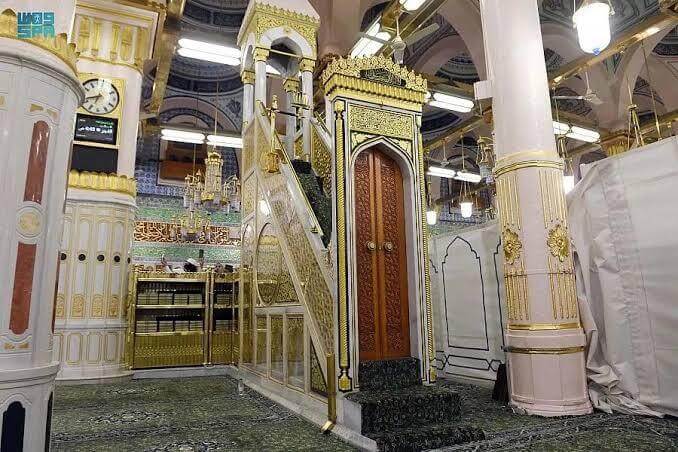
Inside Masjid an-Nabawi in Madinah stands one of the most meaningful landmarks associated with the life and teachings of Prophet Muhammad ﷺ: Mimbar Rasulullah, also known as the Prophet’s Minbar or Mimbar Nabawi.
For centuries, this pulpit has represented an important part of Islamic history. It marks the place associated with the Prophet’s sermons, religious guidance, and communication with his companions.
Many pilgrims visit Madinah hoping to see the historic Minbar and pray in nearby Rawdah Al-Sharifah. However, visitors often have questions about its exact location, original construction, architectural changes, and the arrangements for visiting this part of the mosque.
This guide explains the history of Mimbar Rasulullah, its religious significance, its relationship with Rawdah, and practical information for planning your visit to Masjid Nabawi.
What Is Mimbar Rasulullah?
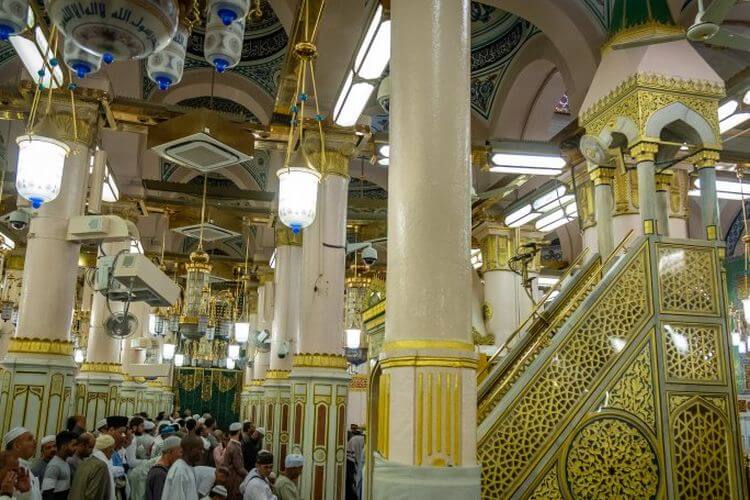
Mimbar Rasulullah (منبر رسول الله) refers to the pulpit associated with Prophet Muhammad ﷺ inside Masjid an-Nabawi in Madinah, Saudi Arabia.
A minbar is an elevated platform traditionally used by an imam to deliver the Friday sermon, known as the Khutbah. Its raised position helps the congregation see and hear the speaker.
During the Prophet’s lifetime, the Minbar served an important practical purpose. As the Muslim community grew, an elevated platform made it easier for people gathered in the mosque to see him while he addressed them.
The first Minbar was a modest wooden structure. The elaborate structure visible today dates from a later historical period and reflects centuries of architectural development at the Prophet’s Mosque.
Mimbar Rasulullah is significant not merely because of its appearance, but because of its association with the Prophet’s teachings and the religious history of Madinah.
Where Is Mimbar Rasulullah Located in Masjid Nabawi?
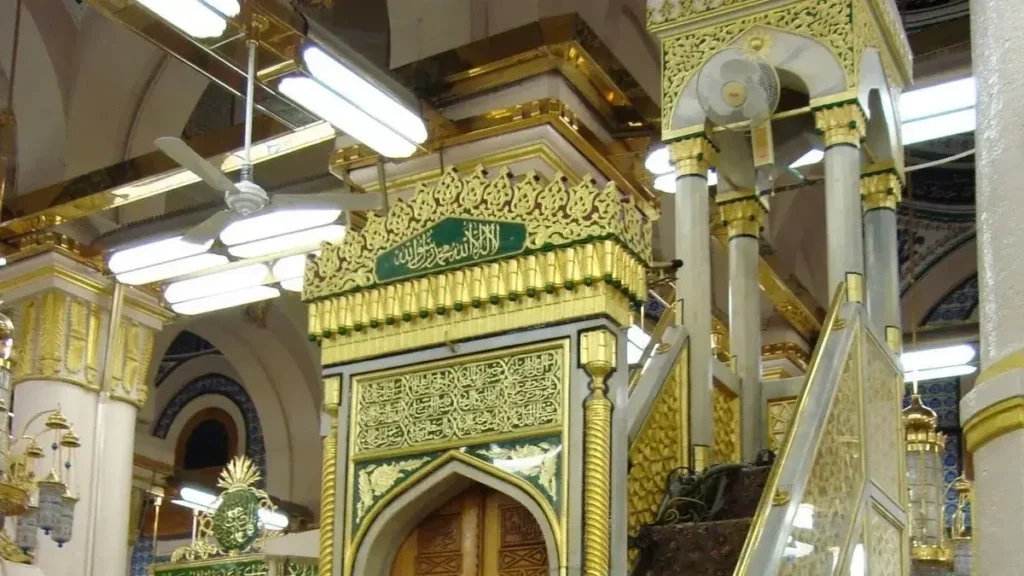
Mimbar Rasulullah is located in the historic southern section of Masjid an-Nabawi, close to the Noble Rawdah and the Mihrab Nabawi.
It stands at the western end of the area traditionally identified as Rawdah Al-Sharifah.
The Prophet’s former residential chamber, now associated with his burial place, lies toward the eastern side of this historic area.
This relationship is particularly important because the Prophet ﷺ described the space between his house and his Minbar as a garden from the gardens of Paradise.
The relationship between Mimbar Rasulullah and Rawdah
Rawdah Al-Sharifah, also called Riyad ul-Jannah, is the sacred section of Masjid Nabawi located between the Prophet’s former house and his Minbar.
According to the Saudi Press Agency, the designated Rawdah area covers approximately 330 square metres, measuring about 22 metres by 15 metres. Saudi Press Agency+1
The Minbar is a key historical landmark for understanding the location of Rawdah.
However, visitors should distinguish between the Minbar itself, the prayer area of Rawdah, and the adjoining chamber of the Prophet ﷺ. These are related but distinct features within the mosque.
History of Mimbar Rasulullah
The history of Mimbar Rasulullah begins during the lifetime of Prophet Muhammad ﷺ and continues through successive periods of Islamic history.
Its development reflects both the changing needs of the congregation and efforts to preserve important landmarks within Masjid Nabawi.
The Prophet’s sermons before the first Minbar
Before a dedicated pulpit was constructed, Prophet Muhammad ﷺ delivered sermons while standing near a date palm trunk.
The trunk provided support during his addresses.
As the congregation increased, a raised pulpit became more useful. A wooden Minbar was subsequently prepared so that the Prophet could address worshippers from a slightly elevated position.
This early structure was simple and functional, very different from the ornate Minbar that exists today.
Who built the original Minbar?
Historical accounts contain differences concerning the identity of the carpenter who made the first Minbar.
Some accounts name a carpenter called Maymun, while other narrations identify the craftsman differently.
The official history published by the Saudi authority responsible for the Two Holy Mosques identifies Maymun as the craftsman favored in the account attributed to Ibn Hajar. alharamain.gov.sa+1
The essential historical point is that the early Minbar was a small wooden pulpit constructed during the Prophet’s lifetime.
How many steps did the original Minbar have?
The Prophet’s Minbar is generally described as having three levels when its seat is included: two steps leading to a sitting platform.
This design was considerably smaller than the Minbar used in later centuries.
Its purpose was not architectural grandeur. It provided a practical place from which the Prophet ﷺ could address the community.
The story of the crying palm tree
One of the best-known narrations associated with the Minbar concerns the date palm trunk beside which the Prophet ﷺ previously delivered sermons.
According to authentic hadith narrations, when he began using the new Minbar, the trunk made an unusual sound. The Prophet approached and comforted it.
The incident is recorded in Sahih al-Bukhari and has remained an important part of Islamic accounts about the Minbar. alharamain.gov.sa
For visitors learning about the early history of Masjid Nabawi, this narration helps explain why the Minbar holds a special place in the religious memory of the mosque.
The Minbar during the Rightly Guided Caliphs
Following the Prophet’s passing, the Minbar continued to be used during the period of the Rightly Guided Caliphs.
Historical accounts describe Abu Bakr and Umar ibn al-Khattab using lower positions on the pulpit out of respect for the Prophet ﷺ.
The Minbar remained closely connected with the leadership of the Muslim community and the delivery of religious guidance.
Changes during the Umayyad and Abbasid periods
During the Umayyad period, additional steps were introduced.
Historical accounts associate this enlargement with Marwan ibn al-Hakam during the rule of Muawiyah ibn Abi Sufyan.
The expanded pulpit provided more elevation than the original wooden structure.
Over time, repairs and modifications continued as the mosque developed. During the Abbasid period, the Minbar also received attention because of deterioration and preservation needs.
Fire damage and reconstruction
The Minbar did not remain physically unchanged throughout Islamic history.
A major fire affecting Masjid Nabawi in the thirteenth century damaged the historic structure.
A replacement was subsequently sent by al-Muzaffar, the ruler of Yemen.
Later rulers, including Mamluk sultans, commissioned additional pulpits for the mosque.
Another significant fire in the fifteenth century led to further reconstruction.
These events explain why the Minbar visible today is not the same wooden structure used during the Prophet’s lifetime.
The Ottoman Minbar Seen in Masjid Nabawi Today
The current Minbar is associated with Ottoman Sultan Murad III and dates to the late sixteenth century.
According to the official Alharamain historical account, the Ottoman Minbar was installed in 998 AH, approximately 1590 CE. alharamain.gov.sa
The structure was designed with fine decorative details, marble construction, and architectural features characteristic of Ottoman craftsmanship.
It has remained one of the most recognizable historical furnishings inside Masjid Nabawi.
Although the materials and appearance changed over the centuries, the Minbar continues to mark a location of exceptional historical importance.
Architectural features of the current Minbar
The existing Minbar combines several notable architectural elements.
Its principal features include a marble structure, decorative stairway, carved surfaces, geometric ornamentation, Arabic calligraphy, and a canopy supported by columns.
Gold-toned decorative elements contribute to its distinctive appearance.
According to the official historical description, the Ottoman-era pulpit has twelve steps in total, including steps outside and within its entrance. alharamain.gov.sa
The ornate design reflects the architectural traditions of its period, while its placement preserves the historical relationship between the Minbar and the Rawdah.
The structure has also received conservation and protective treatment during the modern Saudi era.
Religious Significance of Mimbar Rasulullah
The importance of Mimbar Rasulullah comes primarily from its association with Prophet Muhammad ﷺ and the authentic hadith narrations connected to its location.
The Minbar was a place from which the Prophet instructed his companions, delivered sermons, and communicated religious teachings.
Its historical position also helps identify the Noble Rawdah, one of the most spiritually significant areas within Masjid Nabawi.
The authentic hadith about the Minbar and Rawdah
A narration reported by Abu Hurairah and recorded in Sahih al-Bukhari states:
Between my house and my pulpit there is a garden of the gardens of Paradise.
This statement establishes the special significance of the area between the Prophet’s former house and his Minbar.
Reference: Sahih al-Bukhari, Hadith 1196. Sunnah
The narration explains why many visitors to Madinah wish to pray in Rawdah Al-Sharifah.
However, the hadith should not be understood as establishing a separate ritual involving touching or climbing the Minbar.
Is there a special prayer at Mimbar Rasulullah?
There is no separate prescribed prayer that requires a worshipper to stand beside, touch, or climb the Minbar.
Visitors who receive permission to enter Rawdah may offer voluntary prayers there, subject to the rules and instructions governing the area.
The appropriate approach is to concentrate on worship and maintain respect for the mosque and other visitors.
How to Visit Mimbar Rasulullah in Masjid Nabawi
Visiting the Prophet’s Mosque is an important part of many Muslim travellers’ journeys to Madinah.
The Minbar stands within the historic prayer area, where access and visitor movement are carefully managed.
Can visitors see Mimbar Rasulullah?
The Minbar is a physical landmark inside Masjid Nabawi, but the ability to approach or view it from a particular position depends on the designated routes, barriers, and arrangements operating during a visit.
A Rawdah reservation does not provide unrestricted access to the Minbar itself.
Visitors should follow the directions of mosque staff rather than attempting to enter restricted sections.
How to book a Rawdah visit through Nusuk
The Saudi Ministry of Hajj and Umrah provides a digital appointment service for prayer visits to Rawdah Al-Sharifah.
Rawdah booking process
- Open the official Nusuk application.
- Sign in using your registered account.
- Select the Rawdah prayer permit service for men or women.
- Choose an available date and appointment time.
- Add companions if the service permits.
- Review and confirm the reservation.
- Follow the displayed entry instructions and arrive in time for your appointment.
The official Rawdah permit service is free. Available appointments and access arrangements are controlled by the relevant Saudi authorities.
Official Nusuk Rawdah booking information
The Saudi Press Agency’s October 20, 2026 update confirms that visiting arrangements differ for men and women and may also vary between weekdays and Fridays. Always check your confirmed booking rather than relying on an old published timetable. Saudi Press Agency+1
Etiquette when visiting the Minbar area
Masjid Nabawi welcomes large numbers of worshippers from many countries.
Maintaining a calm and respectful atmosphere benefits everyone.
Visitors should avoid pushing, obstructing passageways, raising their voices, or attempting to touch protected historical structures.
Photography should never interfere with worshippers or conflict with staff instructions.
A visit to this historic area is more meaningful when attention remains on prayer, reflection, and the teachings associated with the Prophet ﷺ.
Getting to Masjid Nabawi in Madinah
For travellers arriving from outside Madinah, transportation planning is an important part of the visit.
Masjid an-Nabawi is located in central Madinah, surrounded by hotels, pedestrian areas, and roads serving the mosque district.
Your transportation arrangements will depend on whether you arrive through Madinah Airport, travel from Makkah, or are already staying in the city.
From Prince Mohammad Bin Abdulaziz International Airport
Visitors arriving at Madinah Airport can travel to their accommodation near Masjid Nabawi by taxi or a prearranged private vehicle.
A direct hotel transfer may be useful for families travelling with children, older passengers, or additional luggage.
Before booking, confirm your arrival terminal, hotel address, passenger count, and baggage requirements.
From Makkah to Madinah
Many pilgrims include Madinah in their travel plans before or after performing Umrah in Makkah.
Private intercity transport offers a direct journey between the two cities, with pickup and drop-off locations arranged in advance.
Road travel typically takes several hours, although the actual journey depends on traffic, rest stops, and the selected route.
Travellers should allow sufficient time for hotel check-in, prayers, and any scheduled Rawdah appointment.
Choosing the right vehicle for your visit
Different passenger groups may need different transport arrangements.
| Travel group | Vehicle option | Practical consideration |
|---|---|---|
| Solo traveller or couple | Toyota Camry | Suitable for smaller parties with limited luggage |
| Family | Hyundai Staria | Additional passenger and luggage space |
| Private premium transfer | GMC Yukon | SUV option for a smaller group |
| Larger family or group | Toyota Hiace | Group transport with luggage arrangements |
| Organised group | Toyota Coaster | Larger-capacity group transportation |
Vehicle availability and suitability should always be confirmed before travel, particularly when carrying large suitcases or mobility equipment.
Planning Your Madinah Visit with Al Maqam Transport
A visit to Masjid Nabawi often forms part of a longer journey that includes airport arrivals, hotel transfers, and visits to historical locations across Madinah.
Al Maqam Transport provides private transportation options for travellers visiting Makkah, Madinah, and Jeddah.
Passengers can enquire about airport pickups, intercity journeys, hotel transfers, and Madinah Ziyarat transportation.
When planning a transfer, share your pickup location, destination, travel date, group size, and luggage requirements.
For a Rawdah appointment, allow a suitable buffer between vehicle arrival and the permitted entry time. A taxi can bring you near the mosque district, but entry into Rawdah remains subject to official arrangements.
Nearby Historical Places to Explore in Madinah
Visitors interested in the history of Mimbar Rasulullah may also appreciate other important Islamic landmarks around Madinah.
Quba Mosque
Recognised as the first mosque established by the Prophet ﷺ after his migration to Madinah. It remains an important destination for visitors interested in early Islamic history.
Mount Uhud
The mountain associated with the Battle of Uhud, a major event in early Islamic history. Visitors can learn about the battle and its historical setting.
Masjid al-Qiblatain
A mosque traditionally associated with the change of the direction of prayer toward the Kaaba in Makkah.
Jannat al-Baqi
The historic cemetery next to Masjid Nabawi where numerous companions and family members of the Prophet ﷺ are buried. Access is subject to local regulations.
These locations can be considered when planning a Madinah Ziyarat journey. Opening hours, access restrictions, and permitted activities may vary.
FAQs
1. What is Mimbar Rasulullah?
Mimbar Rasulullah is the historic pulpit associated with Prophet Muhammad ﷺ inside Masjid an-Nabawi in Madinah. It marks the place where the Prophet delivered sermons and taught his companions.
2. Where is Mimbar Rasulullah located?
The Minbar stands in the historic southern section of Masjid Nabawi, near the Mihrab Nabawi, at the western side of the Noble Rawdah.
3. Is the original Minbar of the Prophet still there?
No. The wooden Minbar used during the Prophet’s lifetime was damaged or lost through historical changes and fires. The present structure dates to the Ottoman period.
4. Who built the first Minbar?
Historical accounts differ, although an account favored by Ibn Hajar identifies a carpenter named Maymun.
5. How many steps did the original Minbar have?
The original pulpit is commonly described as having two steps and a seat, making three levels in total.
6. Who constructed the Minbar currently inside Masjid Nabawi?
The current Ottoman-era Minbar was commissioned under Sultan Murad III and installed around 1590 CE.
7. What is the connection between Mimbar Rasulullah and Rawdah?
The Minbar marks one end of the area described in authentic hadith as lying between the Prophet’s house and pulpit. This area is called Rawdah Al-Sharifah.
8. Can tourists and pilgrims see the Minbar?
Visitors may be able to see the Minbar from permitted areas, depending on mosque access arrangements and staff instructions. Close access is not guaranteed.
9. Is a Nusuk permit required to visit Rawdah?
Yes, a permit or an officially available access arrangement through Nusuk is required for a prayer visit to Rawdah. The booking service is free.
10. Can visitors touch or climb Mimbar Rasulullah?
Visitors should not attempt to touch or climb the protected historic structure. They should respect barriers and follow mosque staff instructions.
11. Is there a special dua for standing near the Minbar?
There is no separate prescribed supplication specifically requiring a visitor to stand beside the Minbar. Worshippers can make appropriate supplications to Allah during their visit.
12. How far is Mimbar Rasulullah from the Green Dome?
Both landmarks are within the historic southern part of Masjid Nabawi. The Minbar is on the western side of Rawdah, while the Prophet’s chamber lies toward the eastern side.
13. Can women visit Rawdah and see the Minbar?
Women can reserve Rawdah visits during designated periods. The applicable route and viewing opportunities depend on current mosque arrangements.
14. How can families travel to Masjid Nabawi?
Families can arrange airport transfers, hotel pickups, or private intercity transport to Madinah. Vehicles should be selected according to passenger numbers, mobility needs, and luggage.
15. Is visiting Mimbar Rasulullah part of the obligatory Umrah rituals?
No. Visiting Masjid Nabawi is a highly valued religious journey, but visiting the Minbar is not an obligatory ritual of Umrah or Hajj.
Final Thoughts
Mimbar Rasulullah is more than an architectural feature inside Masjid Nabawi. Its significance comes from its connection with the Prophet’s sermons, the history of the early Muslim community, and the Noble Rawdah.
From a simple wooden platform to the elaborate Ottoman structure preserved today, the Minbar reflects many centuries of Islamic history.
For visitors arriving in Madinah, understanding this history adds meaning to their time at the Prophet’s Mosque.
With appropriate travel planning, a valid Rawdah appointment where required, and respect for mosque etiquette, pilgrims can make their visit more organised and spiritually meaningful.
Al Maqam Transport can assist with private ground transportation as part of a Madinah itinerary, allowing travellers to arrange airport, hotel, and Ziyarat journeys according to their needs.

Zeeshan is a professional driver and tour guide who has been living and driving in Saudi Arabia for the past 5 years. With deep knowledge of the roads, landmarks, and Ziyarat locations across Makkah, Madinah, Jeddah, and Taif, he helps pilgrims and travelers enjoy safe, smooth, and well-organized journeys. His experience in Umrah transport, city tours, and airport transfers makes him a trusted expert for visitors exploring Saudi Arabia.