


You’ve just landed at King Abdulaziz International Airport (JED). Your suitcase is heavy, your flight was long, and Makkah is still 80–95 km away. Before you join the queue at the taxi rank or start hunting for the train platform, here’s the short answer: a pre-booked private taxi is the only option that takes you door-to-door, at any hour, with no transfers and no guesswork – but it isn’t the only option, and it isn’t automatically right for every traveler. This guide walks through all four ways to make the trip, what each one actually costs in time, money, and hassle, and how to choose based on your flight time, luggage, and group size.
Quick Answer: Your Four Options at a Glance
| Option | Time (airport to hotel) | Cost (per trip) | Best for |
|---|---|---|---|
| Pre-booked private taxi | 60–90 min, door-to-door | SAR 200–400+ | Families, night flights, heavy luggage, Umrah groups |
| Haramain High-Speed Train | 25–30 min ride + 20–40 min onward transfer | SAR 60–140 + local taxi | Budget solo travelers, light packers, daytime arrivals |
| Public bus (SAPTCO) | 90–120 min, multiple stops | SAR 35–50 | Very tight budgets, no time pressure |
| Airport rank taxi (unbooked) | 60–90 min, variable wait | SAR 300–600 (negotiated) | Not recommended for first-time or night arrivals |
The rest of this guide explains why these numbers look the way they do, and which option actually fits your trip.
Understanding the Route: Jeddah Airport to Makkah
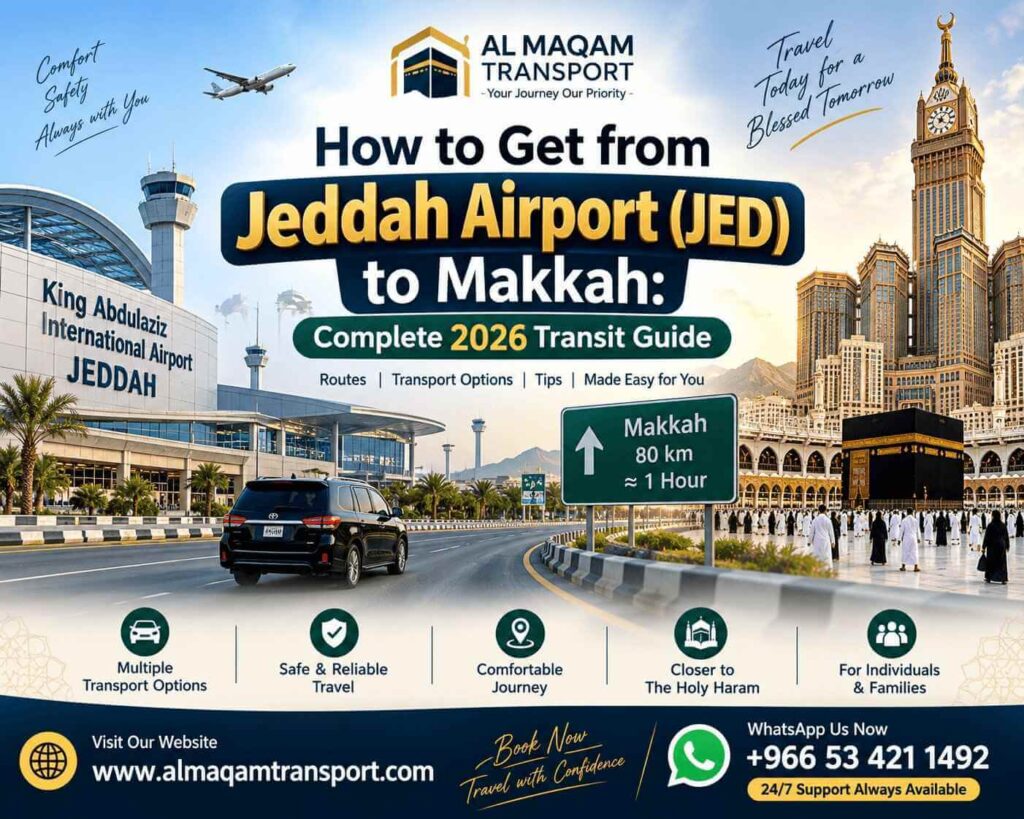
King Abdulaziz International Airport (JED) sits roughly 80–95 km northwest of Makkah, depending on which highway you take and exactly where in the city your hotel sits. Most travelers cover the distance in 60 to 90 minutes by road, though this can stretch to two hours or more during Hajj, Ramadan, and peak Umrah season when the roads around Masjid al-Haram get congested.
There are three main road routes drivers use:
- Al Haramain Expressway – the fastest and most direct route, roughly 90–95 km, about one hour in normal traffic. This is the road pre-booked taxi services use by default.
- Old Makkah Road – a slightly longer route (about 90 km) that passes through older neighborhoods; useful as an alternative when the expressway is congested, but 20–30 minutes slower.
- Coastal/Corniche route – the longest option, mainly used as a detour during heavy traffic rather than a first choice.
One important note for anyone entering Makkah by road for the first time: non-Muslims are not permitted to enter the city of Makkah, and there are checkpoints on the approach roads that enforce this. If you’re traveling with a mixed group, or you’re not sure whether this applies to you, mention it when you book your taxi so the driver can plan the route accordingly.
Option 1: Haramain High-Speed Railway
The Haramain train is genuinely impressive engineering – it runs at up to 300 km/h and covers the Jeddah Airport-to-Makkah leg in about 25–30 minutes, which sounds like the obvious winner. In practice, it comes with three trade-offs that matter for pilgrims specifically.
How it works: The airport station sits inside the KAIA complex, connected to the terminal by covered walkways, so you don’t need a separate transfer to reach the platform. From there it’s a short, comfortable ride to Makkah Railway Station in the Rusaifah district.
What it costs: One-way economy tickets typically run SAR 60–140 depending on class and how far in advance you book; business class costs more. Booking online through the official Haramain (SAR) site or app in advance is strongly recommended, especially during Umrah season, Ramadan, or Hajj, when fares rise and seats sell out.
The catch: Makkah Railway Station is about 3.5 km from Masjid al-Haram – not walking distance with luggage, and not inside the hotel zone most pilgrims stay in. You’ll need a second taxi (or a long walk with bags) to actually reach your hotel, which adds 20–40 minutes and another cost on top of the ticket. The train also runs on a fixed timetable, which rarely lines up neatly with an international flight landing at 2 a.m. or during a delay. If your flight arrives outside train operating hours, or you’re traveling with young children, elderly family members, or Hajj-level luggage, the train stops being the time-saver it looks like on paper.
Option 2: Public Bus (SAPTCO)
The Saudi Public Transport Company runs intercity coaches between Jeddah and Makkah, and it’s the cheapest way to make the trip – fares generally sit in the SAR 35–50 range.
The downside is exactly what you’d expect from any public coach service: multiple stops, fixed departure times, no guarantee of a seat during peak season, and a terminal in Makkah that isn’t next to the Haram either, so you’re arranging local transport again at the end. Total door-to-door time often runs 90 minutes to two hours, and there’s no one to help with bags or track your flight if it’s delayed. It’s a reasonable option if you’re traveling alone, on a strict budget, and have no time pressure – it’s a difficult one with a family, heavy suitcases, or a red-eye arrival.
Option 3: Unbooked Airport Taxi
Walking out of arrivals and hailing a taxi at the rank is the most common thing first-time travelers do, and it’s also where most bad experiences start. Fares are frequently negotiated on the spot rather than metered, wait times at the rank can run long during busy arrival banks, and pricing tends to run higher than a pre-booked fare for exactly the same route – SAR 300–600 is common, sometimes more if you’re visibly a first-time arrival with a full luggage cart. There’s also no guarantee of vehicle condition, driver English, or that the driver actually knows the fastest current route, particularly during road closures around Hajj.
Option 4: Pre-Booked Private Taxi – Why It’s the Standard Choice for Pilgrims
This is where Al Maqam Transport fits in, and it’s worth being specific about what “pre-booked” actually solves rather than just asserting it’s better.
It removes the two biggest failure points of every other option. The train and bus run on fixed schedules that don’t care when your flight actually lands. A pre-booked private taxi does the opposite – the driver tracks your flight number, adjusts for delays automatically, and is waiting when you clear customs, whether that’s 6 a.m. or 2 a.m. There’s no second leg to arrange once you land, because the car takes you straight to your hotel’s front door in Makkah, not to a station 3.5 km away.
It’s built for how pilgrims actually travel. Umrah and Hajj trips rarely mean one small carry-on – they usually mean multiple large suitcases, Zamzam water on the return leg, elderly parents or small children, and Ihram garments that need to be put on before entering the Miqat boundary. A private taxi accommodates all of that: the driver assists with luggage, the vehicle is sized to the group (a Toyota Camry or Hyundai Staria for smaller groups, a Toyota Hiace, GMC Yukon, or Coaster bus for larger families and groups), and there’s no scramble to find a second taxi with room for everyone and their bags.
Pricing is fixed before you fly, not negotiated after you land. You know the fare in advance, which removes the single most common source of stress and disputes at the airport taxi rank.
What a meet-and-greet service actually looks like: your driver monitors your flight, waits inside the arrivals hall (or at a clearly designated point) holding a name board, helps load luggage, and drives you directly to your Makkah hotel using the fastest available route for the time of day – defaulting to Al Haramain Expressway and rerouting around congestion when needed.
Fare guide (Jeddah Airport to Makkah, private taxi):
| Vehicle type | Capacity | Typical fare range |
|---|---|---|
| Sedan (Toyota Camry or similar) | 1–3 passengers, 2–3 bags | SAR 250–350 |
| Van (Hyundai Staria / Toyota Hiace) | 4–7 passengers, 5–7 bags | SAR 350–450 |
| SUV (GMC Yukon) | Small group, luxury/VIP | SAR 450–600 |
| Coaster bus | Large groups (10+) | Quoted per group |
Fares vary with season, time of day, and current fuel/traffic conditions – always confirm your quote at booking.
Which Option Should You Actually Choose?
- Traveling solo, arriving in daylight, packing light, and watching every riyal? The Haramain train is a genuinely good option – just budget the extra time and cost for the onward taxi from Makkah station.
- Traveling with family, an Umrah group, heavy luggage, or landing overnight or during a delayed flight? A pre-booked private taxi removes the variables that cause the most stress on arrival day.
- On the tightest possible budget with no time constraints? The SAPTCO bus is the cheapest way to get there, if you can manage the stops and your own bags.
- Walking to the taxi rank and negotiating on arrival? Workable in a pinch, but expect to pay more than a pre-booked fare for a less certain experience – not recommended for a first Umrah trip or a late-night landing.
Practical Tips for a Smooth Arrival
- Book your transport before you fly, especially during Ramadan, Hajj, and peak Umrah season, when demand for every option – train, bus, and taxi – spikes and prices rise with it.
- Share your flight number when booking a private taxi so the driver can track delays and adjust pickup timing automatically.
- Pack your Ihram accessibly if you’re entering Ihram before reaching the Miqat boundary near Yalamlam or Qarn al-Manazil – your driver can advise on where this applies on your specific route.
- Confirm your fare in writing before departure if you’re booking any private vehicle, so there’s no ambiguity on arrival.
- Allow extra time during Hajj and the last ten days of Ramadan, when road journeys that normally take an hour can stretch to two or more.
- Keep essentials in a carry-on – passport, Umrah permit, medication, and phone charger – regardless of which option you choose, in case luggage handling takes longer than expected.
FAQs
How far is Jeddah Airport from Makkah?
Approximately 80–95 km by road, depending on the route taken, with most journeys completed in 60–90 minutes outside of peak season.
What is the fastest way to get from Jeddah Airport to Makkah?
The Haramain High-Speed Train covers the rail leg in about 25–30 minutes, but total door-to-door time is often similar to a private taxi once you add the onward transfer from Makkah station to your hotel.
Is it better to take the train or a taxi from Jeddah Airport to Makkah?
It depends on your luggage, group size, and arrival time. The train suits light-packing solo travelers arriving during the day; a private taxi suits families, groups, heavy luggage, and any arrival outside standard train hours, since it goes straight to your hotel with no second transfer.
How much does a taxi from Jeddah Airport to Makkah cost?
A pre-booked private taxi typically runs SAR 250–500+ depending on vehicle type and group size. Unbooked airport rank taxis are often priced higher and negotiated on the spot.
Can I book a taxi from Jeddah Airport to Makkah in advance?
Yes, and it’s the recommended approach — advance booking locks in your fare, guarantees a driver is waiting on arrival, and removes the need to negotiate at the rank after a long flight.
Does the Haramain train go directly to Masjid al-Haram?
No. Makkah Railway Station is about 3.5 km from Masjid al-Haram, so you’ll need a local taxi or transfer to reach the mosque or your hotel.
Is there a direct bus from Jeddah Airport to Makkah?
SAPTCO intercity buses connect the two cities, though not always with a single direct route from the airport terminal itself, and the Makkah terminal isn’t adjacent to the Haram.
What is the best route by road from Jeddah Airport to Makkah?
Al Haramain Expressway is the fastest and most commonly used route, generally around one hour in normal traffic conditions.
Do I need to enter Ihram before reaching Makkah?
If you’re entering for Umrah or Hajj, you’ll need to be in Ihram before crossing the Miqat boundary on your route (commonly Yalamlam or Qarn al-Manazil, depending on the road taken). Confirm this with your transport provider based on your specific journey.
Can non-Muslims travel from Jeddah Airport toward Makkah?
Non-Muslims are not permitted to enter the city of Makkah itself; checkpoints on the approach roads enforce this. If your group includes non-Muslim travelers, mention it when booking so the route can be planned accordingly.
How much luggage can a private taxi handle for a family or Umrah group?
This depends on the vehicle – a sedan comfortably handles 2–3 bags, while a van like the Hyundai Staria or Toyota Hiace accommodates 5–7 bags along with a larger group. Larger groups and Hajj-level luggage typically call for a Coaster bus.
Is it more expensive to travel from Jeddah Airport to Makkah during Hajj or Ramadan?
Yes. Demand rises sharply across every transport option during these periods, and both train fares and taxi rates tend to increase, while travel times on the road can also lengthen due to congestion. Booking in advance is strongly recommended.
What happens if my flight is delayed and I’ve booked a private taxi?
A reputable pre-booked service tracks your flight number and adjusts pickup timing automatically, so a delay doesn’t leave you stranded or charged extra for a missed pickup – confirm this policy when you book.
Is a private taxi safer than public transport for solo female travelers or families?
A licensed, pre-booked private taxi service with vetted drivers offers more control over the journey – no unplanned stops, no unfamiliar co-passengers, and a known drop-off point – which many families and solo travelers prefer over shared public options.
Al Maqam Transport provides pre-booked private taxi and chauffeur services between Jeddah Airport, Makkah, and Madinah, including 24/7 airport pickup, flight tracking, and vehicles sized for solo travelers through large Umrah and Hajj groups.
Zeeshan is a professional driver and tour guide who has been living and driving in Saudi Arabia for the past 5 years. With deep knowledge of the roads, landmarks, and Ziyarat locations across Makkah, Madinah, Jeddah, and Taif, he helps pilgrims and travelers enjoy safe, smooth, and well-organized journeys. His experience in Umrah transport, city tours, and airport transfers makes him a trusted expert for visitors exploring Saudi Arabia.