


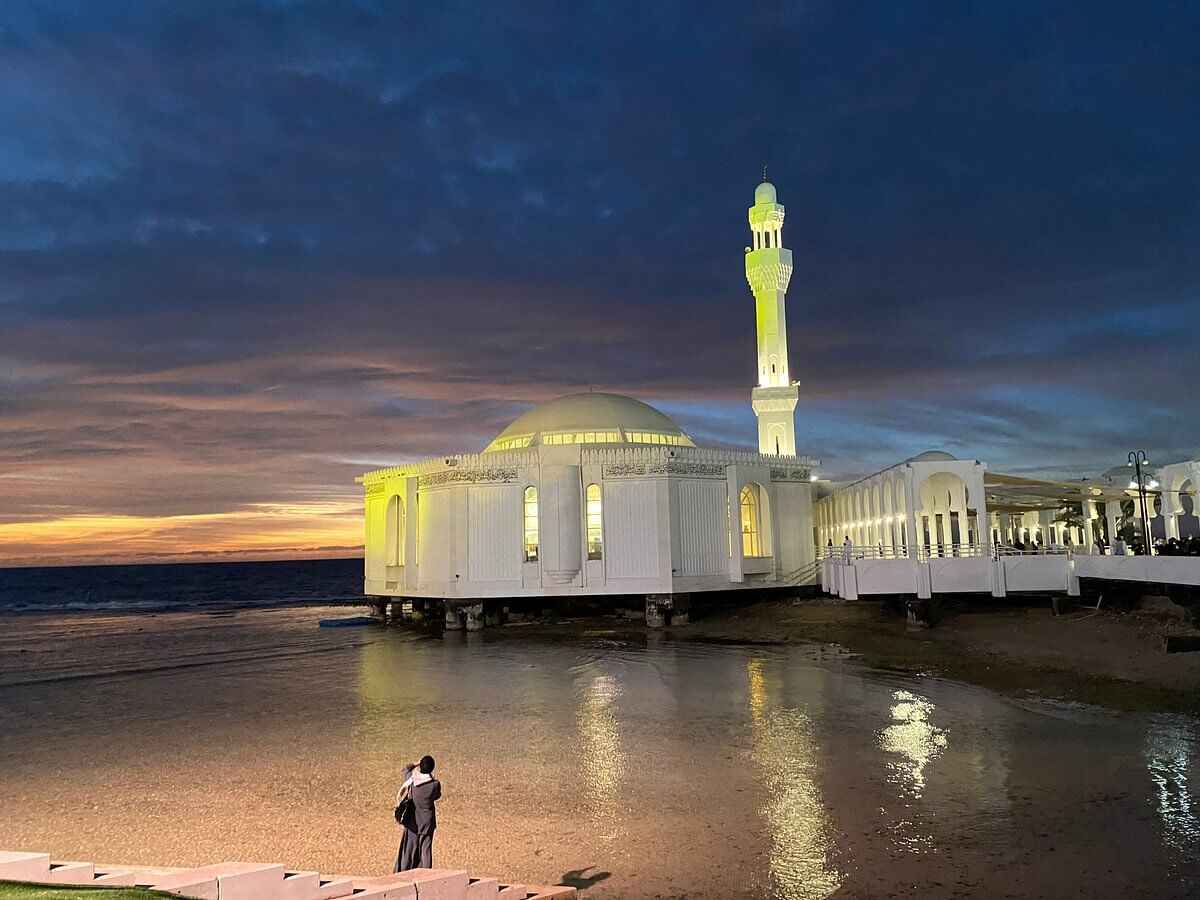
Al Rahma Mosque is a white and turquoise mosque on the northern Corniche of Jeddah, built on stilts over the edge of the Red Sea. Locals also call it the Floating Mosque, and some know it as Fatima Al-Zahra Mosque. It was completed in 1985, it is still a working place of worship, and it is one of the easiest and most memorable stops for anyone passing through Jeddah on the way to Makkah or Madinah.
Most visitors reach it in under an hour from the city centre, and it takes about an hour or two to enjoy properly. This guide explains what you are looking at, how to behave inside, when to go, and how to get there without stress, including how a private taxi fits into a Jeddah stopover.
Quick facts
- Names: Al Rahma Mosque (Masjid Al-Rahma), Fatima Al-Zahra Mosque, the Floating Mosque
- Location: Northern Jeddah Corniche, on the Red Sea coast, Makkah Province, Saudi Arabia
- Completed: 1985
- Area: About 2,400 square metres
- Design: One main dome, 52 smaller domes, and 23 external canopies, according to Saudi heritage sources
- Entry: Free, and open to Muslims and, outside prayer times, to respectful non-Muslim visitors
- Typical visit length: 1 to 2 hours, including the waterfront
Opening hours and access rules can change, especially around prayer times and public holidays, so confirm on the day with your driver or hotel.
What is Al Rahma Mosque?
Al Rahma Mosque is a functioning masjid and one of the best-known landmarks of Jeddah. It sits on the Red Sea coast in the al-Shate’ area, close to the northern Corniche, and it is reached by a low-walled walkway from the shore. The word rahma means mercy in Arabic, which gives the mosque a name that fits its calm setting.
Pilgrims often meet it for the first time on a short stop between the airport and Makkah. Residents treat it as a place to pray, and families come in the evening for the sea air. Both groups share the same space, which is why it feels lived-in rather than staged for tourists.
Why is it called the Floating Mosque?
The building rests on pillars set in shallow water at the shoreline. When the water is high and calm, the base of the structure is hidden and the mosque appears to hover above the surface, especially in photographs taken near sunset.
It does not literally float. The effect comes from the stilts, the surrounding water, and the way the white walls reflect light. The Red Sea has a small tidal range compared with oceans, so you should expect a gentle, visual illusion rather than a dramatic rise and fall. Saudi tourism sources describe it as the first mosque of its kind built over the sea.
History and names
The mosque was completed in 1985 and was first known as Fatima Al-Zahra Mosque, named after the daughter of the Prophet Muhammad (peace be upon him). The name Al Rahma later became the common one, and most signs and maps now use it. If you hear either name from a driver or a local, they mean the same place.
Its position was a deliberate choice. Jeddah has been the sea gateway to Makkah for centuries, and a mosque beside the water suits a city that has welcomed pilgrims arriving by ship, and now by air, for generations.
Architecture and what to look for
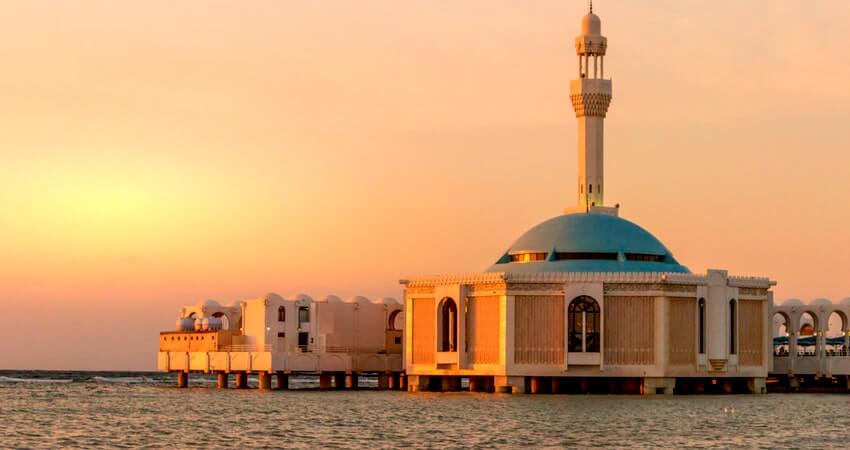
The design blends classical Islamic forms with a modern engineering approach. A few details are worth looking for rather than just photographing from afar.
- The main dome and minaret. A turquoise dome sits above a white structure, with a slim white minaret beside it.
- The supporting columns. Eight columns carry the central dome inside, and a ring of windows lets daylight in around it.
- Calligraphy. Quranic verses are inscribed on the walls in several scripts, including Naskh, Ruq’ah, and Diwani.
- The suspended prayer area. A wooden women’s prayer space hangs above the main hall and is described in Saudi sources as holding about 500 worshippers.
- The open courtyard. This is where most people stand to see the coastline and feel the breeze.
Capacity figures vary by source, with some quoting around 2,300 worshippers across the whole building. Treat any single number as approximate.
Can non-Muslims visit Al Rahma Mosque?
Yes. Al Rahma is among a small number of Jeddah mosques that have been open to non-Muslim visitors for several years, and it is a popular stop for international tourists. Visitors are asked to come outside the five daily prayer times, to be quiet, and to follow the same rules as everyone else.
The exterior and the waterfront can generally be enjoyed at any time. Access to the prayer hall may be limited during prayer, so a short wait is usually the simplest solution. Non-Muslim visitors should avoid walking through lines of worshippers and should not photograph people who are praying.
Dress code and etiquette
Dress modestly, as you would for any mosque in Saudi Arabia.
- Men: Long trousers and a shirt with sleeves are the safe choice. Shorts and sleeveless tops are not appropriate.
- Women: Wear a loose abaya or long, loose clothing covering the arms and legs, and carry a scarf for the hair when entering the prayer area.
- Everyone: Remove shoes before entering the prayer hall, switch your phone to silent, and keep your voice low.
If you arrive without suitable clothing, ask at the entrance whether covering garments are available. Do not count on this, because availability depends on the day.
Photography of the building is common and welcome from the courtyard and the walkway. Be considerate near worshippers, and never use flash during prayer.
Best time to visit Al Rahma Mosque
The best hour of the day is just before sunset. The light turns the white walls gold and then pink, and the heat eases. Early morning, around sunrise, is the quieter option and works well for photographers who want fewer people in the frame.
The best months are November to March. Jeddah summers are hot and humid, and midday on the waterfront can be uncomfortable from roughly May to September.
Avoid the busiest prayer windows if you are a visitor rather than a worshipper. Friday midday is the most crowded period, because of congregational prayer. Evenings and weekends bring more local families.
Ramadan changes the rhythm. In Ramadan, the mosque is busy after iftar and during Taraweeh prayers, and daytime visiting is calmer but quieter in spirit. Plan around the prayer timetable for your date.
Peak Umrah seasons add traffic, not necessarily crowds at the mosque. The main effect is on roads between the airport, Jeddah, and Makkah, so allow extra time on those days.
How to get there
The mosque is on the northern side of Jeddah, which is convenient for arrivals at King Abdulaziz International Airport (JED), because the airport is also in the north.
From King Abdulaziz International Airport: Transfer providers quote roughly 16 to 20 kilometres by road, mostly along King Abdulaziz Road. In normal traffic this is typically a journey of about 20 to 35 minutes, longer in the evening rush.
From central Jeddah and Al Balad: Expect a longer drive, usually 25 to 45 minutes depending on traffic, because the historic district is on the opposite side of the city.
From Makkah: Jeddah is around 80 kilometres from Makkah by road, so the mosque is a natural stop on the way back to the airport after Umrah, rather than a detour.
By public transport: Public options exist but are limited and not convenient for visitors with luggage or children. Most travellers prefer a pre-booked taxi or a hotel transfer.
Parking and drop-off: Vehicle access close to the walkway can be restricted at busy times, so drivers often use the nearest convenient entrance and you walk the final stretch. Ask your driver to wait at an agreed point and share a mobile number.
Using a private taxi for your visit
A private taxi is the simplest way to see the mosque if you have limited time, luggage, or older relatives. You avoid searching for parking, you can stay as long as you wish, and your driver can keep your bags safe while you walk.
A typical plan for Umrah pilgrims with a long layover looks like this:
- Meet your driver at the arrivals hall with a name board.
- Drive to Al Rahma Mosque and spend an hour at the waterfront.
- Continue to your hotel in Jeddah or on to Makkah.
Choosing a vehicle. A sedan such as a Toyota Camry suits one to three travellers. A Hyundai Staria or Toyota Hiace is better for families and small groups with suitcases. Larger groups may prefer a Coaster bus. Executive and luxury options such as a GMC Yukon are available for travellers who want extra space and comfort.
What to confirm before you book:
- Pick-up point and flight number, so the driver can track delays
- Whether the price is fixed and includes tolls and waiting time
- The number of passengers and bags
- Child seats, if travelling with infants
- Whether you want a stop at the mosque added to an airport or hotel transfer
Al Maqam Transport arranges airport transfers, hotel transfers, ziyarat tours, and intercity trips between Jeddah, Makkah, Madinah, and Taif with private drivers, and a mosque stop can be added to any of them. Ask for the final price in writing before the trip.
Combining Al Rahma Mosque with other stops
Because the mosque sits on the Corniche, it pairs easily with other places nearby.
- Jeddah Corniche. A long coastal promenade with walking paths, public art, and cafés, good for an evening stroll after sunset prayer.
- Al Balad (historic Jeddah). A UNESCO World Heritage district with old coral-stone houses and markets, best visited in the late afternoon or evening and treated as a separate outing.
- Jeddah Waterfront and the Red Sea shore. Suitable for families who want open space for children.
- Makkah. If your Umrah is the main purpose of your trip, many pilgrims visit the mosque the day they arrive or the day they leave.
A sensible rule is to pair the mosque with one other stop, not three. The traffic in Jeddah rewards a simple plan.
Accessibility and family travel
The approach is flat and the walkway is paved, which makes it manageable for wheelchair users and for strollers, though the surface can feel warm and busy at peak times. Hotel and travel listings describe step-free access, but conditions at the entrance can vary, so ask your driver about the best drop-off point before you arrive.
For families, go in the late afternoon when it is cooler, bring water and sun protection, and plan on short walking distances. Children are welcome as long as they stay calm and close. Toilets and wudu facilities are available on site, though queues can form near prayer times.
Practical tips from the road
- Check the prayer timetable first. The same visit can feel peaceful or crowded depending on whether you arrive an hour before or after prayer.
- Carry some cash and a charged phone. Cards are widely used in Jeddah, but small purchases at the waterfront are easier with cash.
- Bring a light scarf or shawl. It covers the shoulders or hair quickly and saves you a trip back to the hotel.
- Keep shoes easy to slip off. Sandals are practical for the prayer hall.
- Plan tight flights carefully. If you land in the morning and fly on at night, you can do the mosque comfortably. If you land and depart within a few hours, skip it and keep the margin for immigration and baggage.
- Be respectful with drones. Drone use over public and religious sites is regulated in Saudi Arabia, so check the current rules before flying one.
FAQs
What is Al Rahma Mosque in Jeddah known for?
It is known as the Floating Mosque because it is built on stilts over the Red Sea and appears to hover above the water. It was completed in 1985, and it is both a working mosque and one of Jeddah’s most popular landmarks.
Does Al Rahma Mosque really float?
No. It is supported by pillars set in the shallow shoreline. The floating look comes from the surrounding water, the white walls, and the way the building reflects light, especially around sunset.
Where is Al Rahma Mosque located?
It is on the northern Jeddah Corniche, on the Red Sea coast in the al-Shate’ area, in Makkah Province. It is on the same side of the city as King Abdulaziz International Airport.
Is Al Rahma Mosque open to non-Muslims?
Yes, visitors of all faiths are welcome outside prayer times, provided they dress modestly and behave respectfully. Access to the prayer hall may be limited during prayer.
Is there an entrance fee?
No. Entry is free for everyone, though parking or nearby services may carry their own charges.
What are the opening hours?
As a mosque, it is open for the daily prayers, and visiting arrangements can change. Check locally on the day of your visit, and plan to arrive outside prayer times if you are a non-Muslim visitor.
What should I wear?
Wear modest, loose clothing that covers the shoulders, arms, and legs. Women should carry a scarf for the hair. Remove your shoes before entering the prayer hall.
When is the best time to visit?
Just before sunset gives the best light and cooler air. Early morning is quieter. The most comfortable months are November through March.
How far is Al Rahma Mosque from Jeddah Airport?
Roads distances quoted by transfer providers are roughly 16 to 20 kilometres. In normal traffic, expect about 20 to 35 minutes by car, and longer at rush hour.
How far is it from Makkah?
Makkah is about 80 kilometres from Jeddah by road. The mosque is a convenient stop on the way to or from the airport, adding little time to the journey.
How long should I spend there?
Plan on one to two hours, including time for prayer, photos, and a walk along the waterfront.
Can I visit with a private taxi and driver?
Yes. A private taxi lets you stop at the mosque on the way between the airport, your hotel, or Makkah, and your driver can wait while you visit. Confirm the price and waiting time before you travel.
Is the mosque suitable for children and elderly visitors?
Yes. The approach is flat and paved, and facilities are available on site. Go in the cooler part of the day and keep walking distances short.
Can women visit Al Rahma Mosque?
Yes. Women are welcome, and there is a dedicated prayer area for them. Modest dress and a head covering are expected inside the prayer area.
Final thoughts
Al Rahma Mosque rewards a short, well-timed visit. Go near sunset, dress modestly, respect the prayer schedule, and keep your plan simple. If you are arriving in Jeddah for Umrah or a Saudi holiday, a pre-arranged private transfer turns the stop into an easy part of your journey rather than another thing to organise after a long flight.

Zeeshan is a professional driver and tour guide who has been living and driving in Saudi Arabia for the past 5 years. With deep knowledge of the roads, landmarks, and Ziyarat locations across Makkah, Madinah, Jeddah, and Taif, he helps pilgrims and travelers enjoy safe, smooth, and well-organized journeys. His experience in Umrah transport, city tours, and airport transfers makes him a trusted expert for visitors exploring Saudi Arabia.