


FOUNDATION, PROPHETIC ERA & EARLY ISLAMIC EXPANSIONS
Masjid-e-Nabawi, also known as Al-Masjid an-Nabawi or the Prophet’s Mosque, stands at the spiritual and historical heart of Madinah al-Munawwarah. It is the second holiest mosque in Islam after Masjid al-Haram in Makkah and one of the most significant religious institutions ever established in human history. Unlike monumental structures built by kings or empires, Masjid Nabawi was founded by Prophet Muhammad ﷺ himself as a living center of faith, governance, justice, education, and community life.
Hijrah and the Foundation of Masjid Nabawi (1 AH / 622 CE)
The establishment of Masjid Nabawi began immediately after the Hijrah (migration) of Prophet Muhammad ﷺ from Makkah to Madinah in 622 CE. Upon entering the city, the Prophet ﷺ allowed his camel Al-Qaswa to walk freely until it stopped at a specific location belonging to two orphan brothers from the tribe of Banu Najjar. The land was purchased fairly and designated for the construction of the mosque.
From the very beginning, the Prophet ﷺ personally participated in the construction, carrying bricks alongside his companions. This act established a powerful ethical precedent of humility, leadership, and shared responsibility. The mosque was not intended to be merely a place for ritual prayer; rather, it functioned as the central institution of the first Islamic society.
Original Structure and Architectural Simplicity
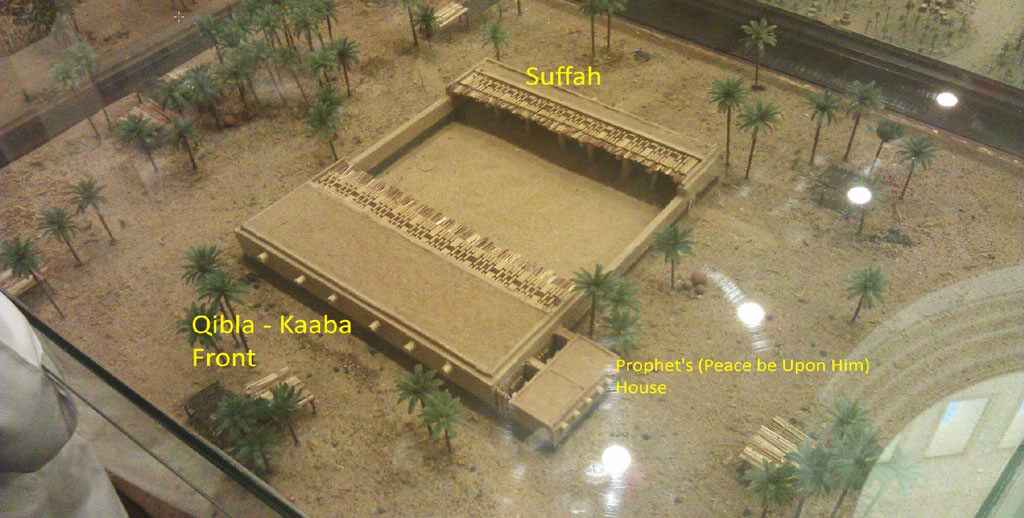
The first Masjid Nabawi was built using locally available materials, reflecting simplicity and purpose. The walls were constructed from sun-dried mud bricks, the roof was supported by date-palm trunks, and palm leaves were used as roofing material. The floor consisted of sand and small pebbles.
The mosque had an open courtyard and three entrances. Initially, the Qiblah (direction of prayer) was towards Jerusalem (Bayt al-Maqdis). After divine revelation, the Qiblah was changed to face the Kaaba in Makkah, a moment that permanently defined Islamic worship orientation.
Within the mosque, a shaded platform known as Ahl al-Suffah was established to shelter poor companions who devoted themselves to learning the Quran and Islamic teachings. This made Masjid Nabawi the first residential educational institution in Islam.
Religious and Social Role During the Prophetic Era
During the lifetime of Prophet Muhammad ﷺ, Masjid Nabawi served multiple essential functions. It was a place for daily prayers, Friday sermons, judicial rulings, military planning, diplomatic meetings, and community welfare. Major decisions affecting the Muslim Ummah were made within its walls.
Importantly, the mosque embodied the concept that Islam integrates worship with social responsibility, a principle that continues to shape Islamic civilization.
Recommended: What Was Inside the Kaaba?
First Expansion by Prophet Muhammad ﷺ (7 AH)
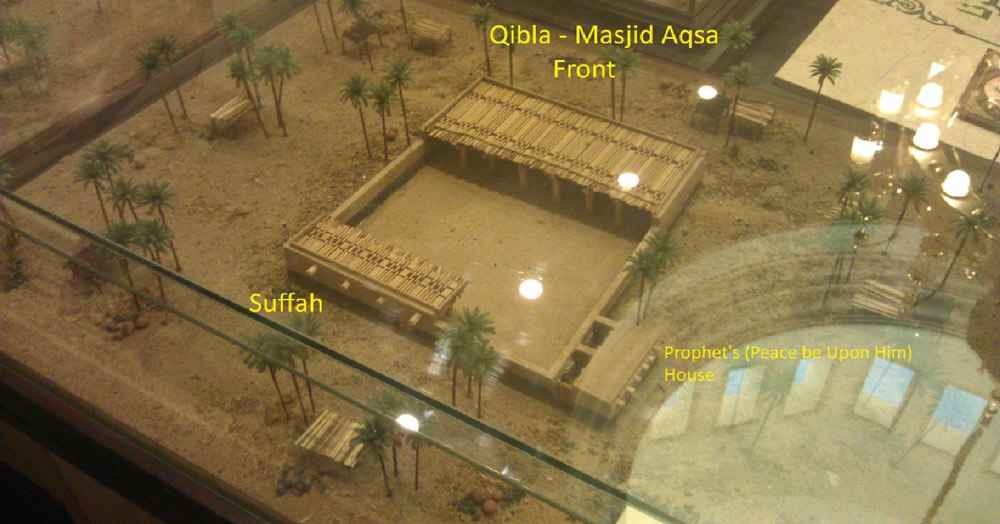
As the Muslim population of Madinah grew following the Treaty of Hudaybiyyah and the conquest of Khaybar, the mosque became insufficient to accommodate worshippers. In 7 AH, Prophet Muhammad ﷺ ordered the first expansion of Masjid Nabawi. The mosque was enlarged primarily toward the north, while maintaining the same simple architectural style and materials.
This expansion reinforced the idea that mosque growth should respond to community needs, not symbolic grandeur.
Expansion Under Caliph Umar ibn al-Khattab (17 AH / 638 CE)
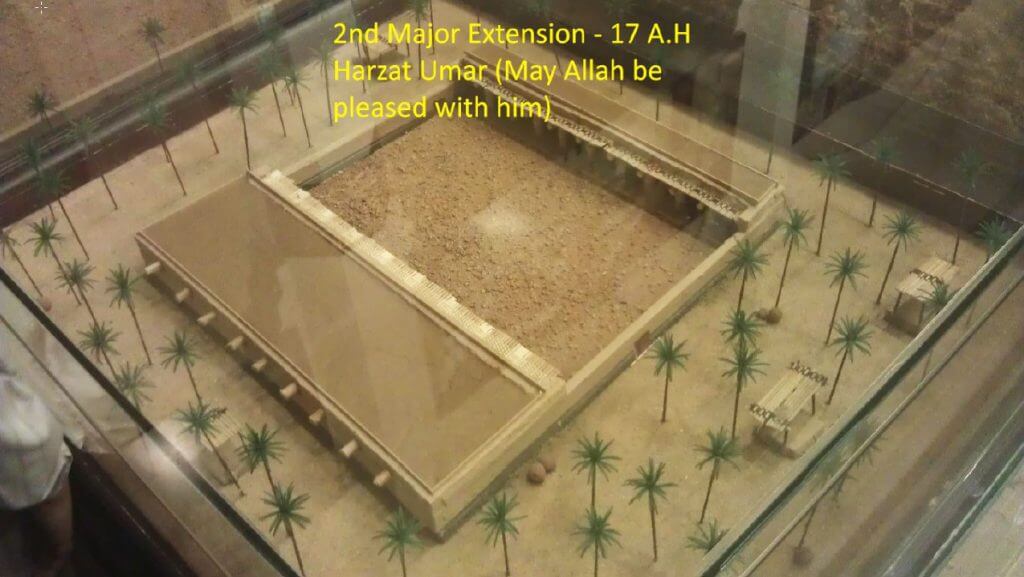
Following the passing of Prophet Muhammad ﷺ, the responsibility of maintaining and expanding Masjid Nabawi passed to the Rightly Guided Caliphs. During the caliphate of Umar ibn al-Khattab, the rapidly expanding Muslim population in Madinah required further enlargement of the mosque.
In 17 AH, Umar expanded the mosque significantly, increasing its area while preserving its modest character. He introduced lamps for nighttime illumination and implemented organizational improvements, ensuring cleanliness and order. However, he deliberately avoided decorative elements, reflecting his emphasis on humility and functionality.
Expansion Under Caliph Uthman ibn Affan (29 AH / 649 CE)
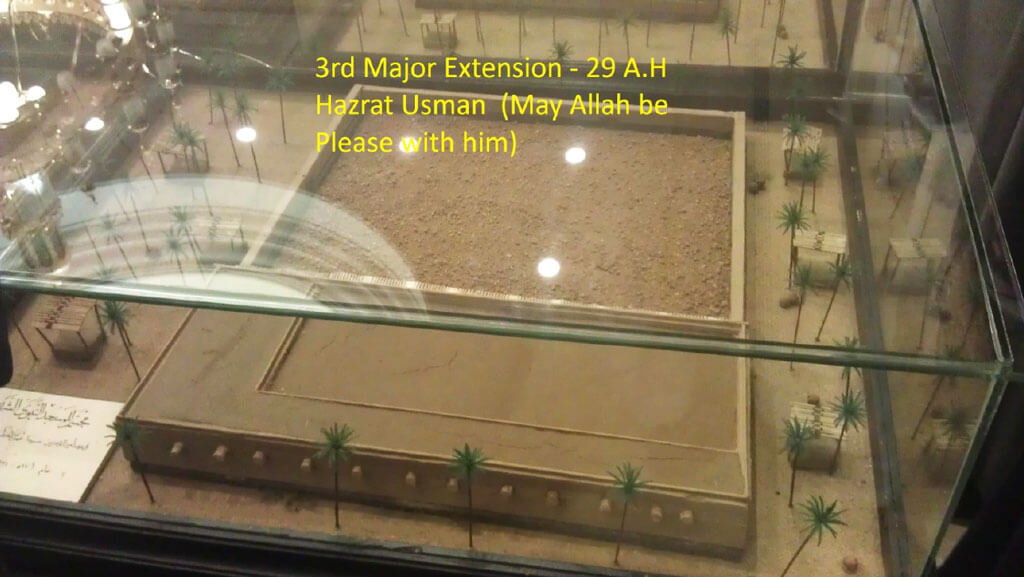
The third caliph, Uthman ibn Affan, carried out another major expansion in 29 AH. Unlike previous constructions, this expansion introduced stone walls and teak wood columns, marking the first transition toward durable architectural materials.
Although this represented a structural advancement, the mosque retained its spiritual simplicity. Uthman’s expansion allowed larger congregations while strengthening the building’s longevity.
Umayyad Expansion Under Caliph Al-Walid ibn Abd al-Malik (88–91 AH)
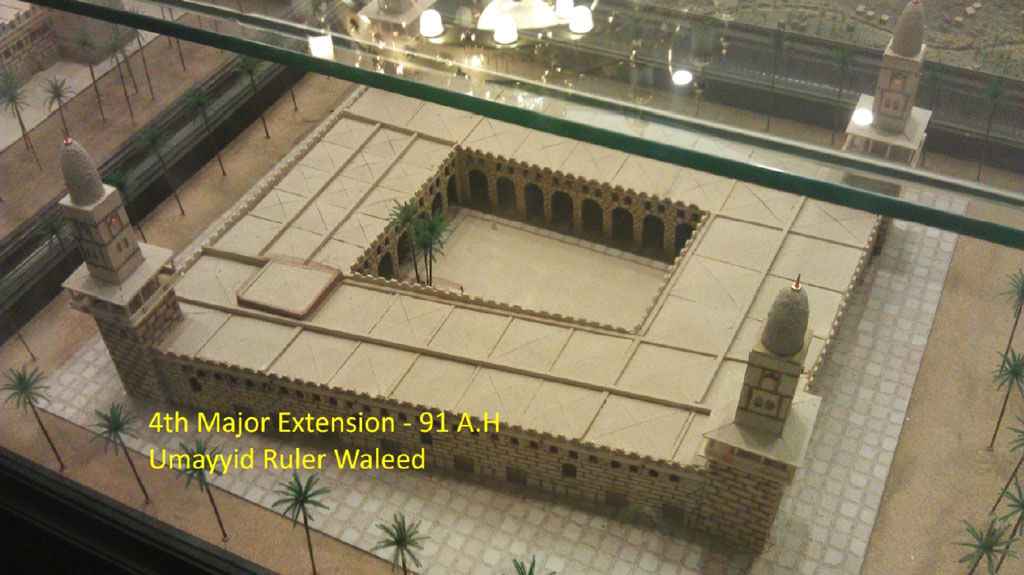
The most transformative early expansion occurred during the Umayyad period under Caliph Al-Walid ibn Abd al-Malik. Governed locally by Umar ibn Abdul Aziz, this expansion fundamentally reshaped Masjid Nabawi.
Between 88 and 91 AH, the mosque was rebuilt using stone, marble, and decorative mosaics, and for the first time, minarets were added. Crucially, the Hujrah (living quarters) of Prophet Muhammad ﷺ, which contained his grave, was incorporated into the mosque structure.
This expansion marked the transition of Masjid Nabawi from a simple community mosque into a grand architectural symbol of Islamic civilization, while still preserving its spiritual essence.
SAUDI EXPANSIONS, ARCHITECTURAL SYSTEMS & MODERN SIGNIFICANCE
King Fahd bin Abdulaziz Expansion (1985–1994): The Transformation into a Global Pilgrimage Complex
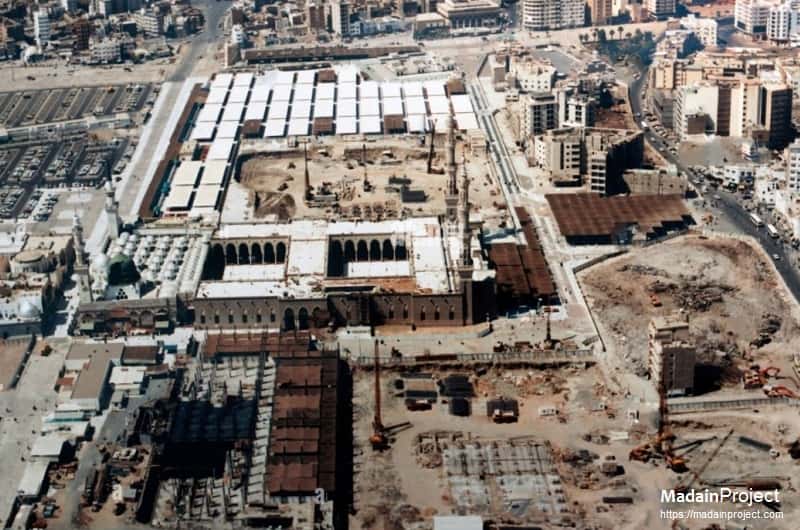
The expansion undertaken during the reign of King Fahd bin Abdulaziz Al Saud represents a turning point in the history of Masjid Nabawi, elevating it from a monumental historical mosque into a fully integrated global pilgrimage complex. This project was not merely an extension of space; it was a comprehensive redevelopment that addressed the growing logistical, climatic, and safety needs of millions of worshippers visiting Madinah each year.
The mosque’s built-up area was expanded significantly on the western side, while the surrounding courtyards were redesigned to facilitate large-scale congregational movement. Underground levels were introduced to house ablution facilities, service corridors, technical systems, and storage, allowing the prayer areas above to remain uncluttered and serene. For the first time in its history, Masjid Nabawi was equipped with central air-conditioning, a crucial adaptation to Madinah’s extreme climate.
Architecturally, the expansion maintained visual harmony with Ottoman elements while incorporating reinforced concrete structures hidden beneath marble cladding. The number of domes was increased, and advanced lighting systems were installed to ensure uniform illumination during night prayers. By the completion of King Fahd’s expansion, Masjid Nabawi could accommodate hundreds of thousands of worshippers simultaneously, setting a new global standard for mosque design.
King Abdullah bin Abdulaziz Expansion (2010–2012): Engineering for Comfort and Climate
The expansion initiated under King Abdullah bin Abdulaziz focused primarily on the external courtyards and environmental comfort rather than interior structural enlargement. This phase addressed one of the greatest challenges facing Masjid Nabawi: protecting worshippers from intense heat during peak prayer times.
The most distinctive feature of this expansion was the installation of giant retractable umbrella structures, engineered by international specialists and designed specifically for Masjid Nabawi. These umbrellas open automatically during the day to provide shade and close at night to preserve open views of the sky. Each umbrella is equipped with misting systems, lighting units, and drainage channels, transforming the courtyards into thermally controlled prayer spaces.
The courtyards were paved with heat-resistant marble, which remains cool even under direct sunlight. Beneath the surface, a sophisticated network of cooling pipes and service tunnels ensures efficient temperature regulation. This expansion alone increased the mosque’s effective capacity by hundreds of thousands, enabling safe and comfortable worship during Ramadan and Hajj seasons.
King Salman Era Enhancements: Technology, Crowd Management & Preservation
While no massive structural expansion has yet surpassed the scale of King Abdullah’s project, the era of King Salman bin Abdulaziz has focused on operational excellence, digital transformation, and preservation. Advanced crowd-management systems, smart surveillance, and AI-assisted monitoring have been implemented to ensure safety without disturbing the spiritual atmosphere.
Restoration projects have also been carried out to preserve historic Ottoman columns, inscriptions, and decorative elements, ensuring that modernization does not erase historical identity. These efforts reflect a shift from expansion-driven growth to sustainability-focused stewardship.
Rawdah al-Sharifah: Organization and Sacred Access
At the spiritual core of Masjid Nabawi lies Rawdah al-Sharifah, the area between the Prophet’s ﷺ house and pulpit, described in authentic hadith as a garden from Paradise. Due to its immense religious significance, Rawdah has always attracted overwhelming crowds.
In recent years, access to Rawdah has been organized through digital permit systems, allowing worshippers to pray peacefully while preventing overcrowding. This modern administrative approach ensures fairness, safety, and reverence, aligning contemporary management with prophetic tradition.
The Sacred Chamber and the Green Dome
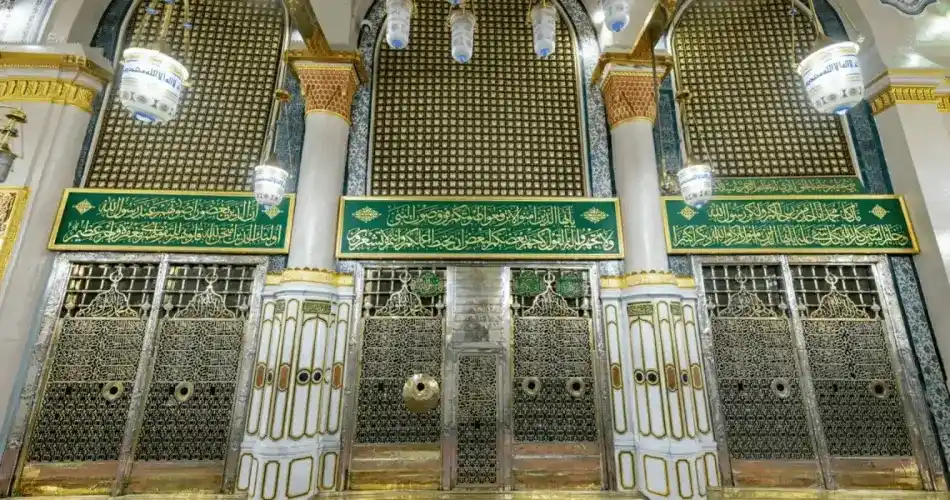
The Sacred Chamber (Al-Hujrah al-Sharifah) houses the graves of Prophet Muhammad ﷺ, Abu Bakr al-Siddiq, and Umar ibn al-Khattab. Over centuries, strict protective measures have been enforced around this area to prevent structural interference or misuse.
The Green Dome, which visually marks the Prophet’s resting place, remains unchanged in position and form despite surrounding expansions. Its preservation across centuries symbolizes the continuity of Islamic reverence and respect for prophetic legacy.
Modern Architectural Systems and Capacity
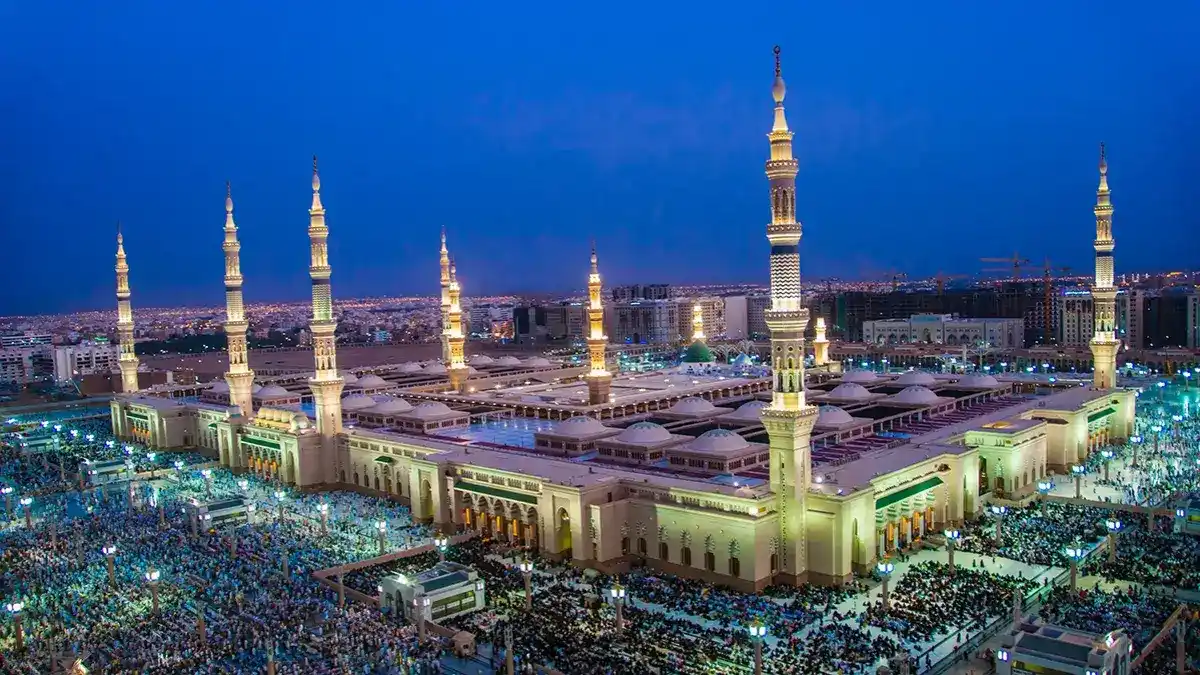
Today, Masjid Nabawi spans more than 400,000 square meters, with prayer capacity reaching approximately 1.8 million worshippers during peak periods. The mosque contains:
- 27 movable domes that regulate airflow and light
- 10 minarets, some exceeding 100 meters in height
- Fully integrated cooling, lighting, and acoustic systems
- Underground service cities supporting daily operations
Every architectural decision prioritizes worshipper comfort, safety, and spiritual focus, reinforcing Masjid Nabawi’s role as a living mosque rather than a static monument.
Masjid Nabawi as a Living Legacy
Despite fourteen centuries of expansion, reconstruction, and modernization, Masjid Nabawi remains true to its original mission established by Prophet Muhammad ﷺ. It continues to serve as a place of prayer, knowledge, compassion, and unity for Muslims from every corner of the world.
Each expansion—whether by the Prophet ﷺ himself, the Rightly Guided Caliphs, Islamic empires, or the Saudi state—has respected the mosque’s sacred character while responding to the evolving needs of the Ummah. This balance between tradition and innovation is what makes Masjid Nabawi not only an architectural wonder, but a timeless spiritual institution.
FAQs.
1. What is Masjid-e-Nabawi and why is it important?
Masjid-e-Nabawi, also known as the Prophet’s Mosque, is the second holiest mosque in Islam. It was built by Prophet Muhammad ﷺ in Madinah and serves as a central place of worship, learning, and spiritual significance for Muslims worldwide.
2. When was Masjid-e-Nabawi built?
Masjid-e-Nabawi was built in 1 AH (622 CE) immediately after the Hijrah of Prophet Muhammad ﷺ from Makkah to Madinah.
3. Who is buried inside Masjid-e-Nabawi?
Inside the Sacred Chamber of Masjid-e-Nabawi are the graves of Prophet Muhammad ﷺ, Abu Bakr al-Siddiq, and Umar ibn al-Khattab.
4. What is Rawdah al-Sharifah?
Rawdah al-Sharifah is the area between the Prophet’s ﷺ house and pulpit. According to authentic hadith, it is described as a garden from the gardens of Paradise, making it one of the most sacred places in Islam.
5. How many times has Masjid-e-Nabawi been expanded?
Masjid-e-Nabawi has undergone multiple expansions across Islamic history, including expansions by Prophet Muhammad ﷺ, the Rightly Guided Caliphs, Umayyad, Abbasid, Mamluk, Ottoman rulers, and major modern expansions under Saudi kings.
6. Which caliph first expanded Masjid-e-Nabawi?
The first expansion was carried out by Prophet Muhammad ﷺ himself in 7 AH, followed by expansions under Caliph Umar ibn al-Khattab and Caliph Uthman ibn Affan.
7. When was the Green Dome built?
The dome over the Prophet’s ﷺ grave was originally constructed in 1279 CE during the Mamluk period and was later painted green in 1837 CE during the Ottoman era.
8. What are the major Saudi expansions of Masjid-e-Nabawi?
Major Saudi expansions were carried out under King Abdulaziz, King Fahd, King Abdullah, and later enhancements under King Salman, significantly increasing capacity, comfort, and infrastructure.
9. How many worshippers can Masjid-e-Nabawi accommodate today?
Masjid-e-Nabawi can accommodate up to 1.8 million worshippers during peak times, including prayer halls and surrounding courtyards.
10. How many minarets does Masjid-e-Nabawi have?
Masjid-e-Nabawi has 10 minarets, making it one of the most architecturally distinctive mosques in the world.
11. What makes Masjid-e-Nabawi’s architecture unique?
Masjid-e-Nabawi uniquely blends traditional Islamic architecture with modern engineering, featuring movable domes, retractable umbrellas, advanced cooling systems, and historic Ottoman design elements.
12. Is special permission required to pray in Rawdah?
Yes, access to Rawdah al-Sharifah is managed through an official digital permit system to ensure safety, organization, and equal access for worshippers.
13. Can visitors pray anywhere inside Masjid-e-Nabawi?
Yes, visitors can pray throughout Masjid-e-Nabawi, but Rawdah al-Sharifah requires scheduled access due to its limited space and high demand.
14. Why is Masjid-e-Nabawi important during Umrah and Ziyarat?
Masjid-e-Nabawi is a central destination for Umrah and Ziyarat travelers, as visiting Madinah and offering salutations to the Prophet ﷺ is a deeply spiritual and recommended act.
15. How is Masjid-e-Nabawi managed today?
Masjid-e-Nabawi is managed by Saudi authorities using advanced technology, crowd-management systems, and preservation programs to ensure safety, cleanliness, and spiritual integrity.

Zeeshan is a professional driver and tour guide who has been living and driving in Saudi Arabia for the past 5 years. With deep knowledge of the roads, landmarks, and Ziyarat locations across Makkah, Madinah, Jeddah, and Taif, he helps pilgrims and travelers enjoy safe, smooth, and well-organized journeys. His experience in Umrah transport, city tours, and airport transfers makes him a trusted expert for visitors exploring Saudi Arabia.