


Maqam Ibrahim—the Station of Abraham—is one of the most revered physical symbols in Islam. Located within Masjid al-Haram in Makkah, near the Holy Kaaba, it is directly connected to the life of Prophet Ibrahim (peace be upon him) and the construction of the Kaaba. Its significance is not cultural or symbolic alone; it is explicitly affirmed by the Qur’an, practiced by the Prophet Muhammad ﷺ, and preserved through Islamic history.
What Is Maqam Ibrahim?
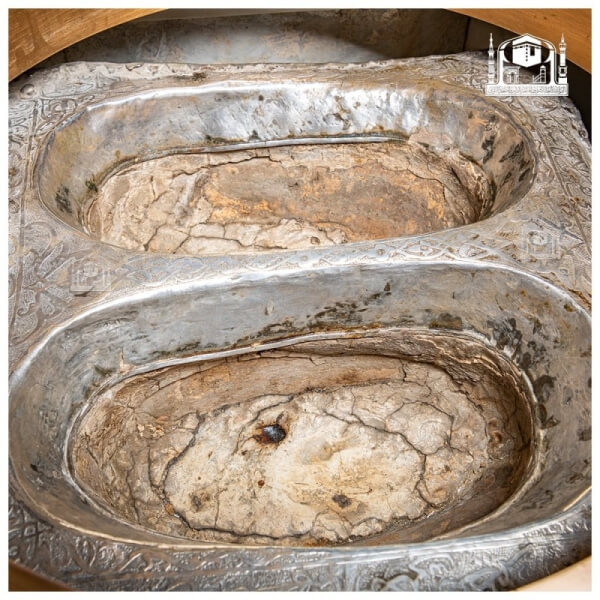
Maqam Ibrahim refers to the sacred stone upon which Prophet Ibrahim stood while raising the foundations and upper walls of the Kaaba with his son Ismail (AS). According to authentic Islamic tradition, the stone softened beneath Ibrahim’s feet by Allah’s command, leaving visible imprints that remain associated with the site to this day.
The word maqam linguistically means station or standing place, emphasizing both the physical location and the spiritual status of this act of worship.
وَإِذْ يَرْفَعُ إِبْرَٰهِـۧمُ ٱلْقَوَاعِدَ مِنَ ٱلْبَيْتِ وَإِسْمَـٰعِيلُ رَبَّنَا تَقَبَّلْ مِنَّآ ۖ إِنَّكَ أَنتَ ٱلسَّمِيعُ ٱلْعَلِيمُ ❁
As Ibrahim and Ismail built up the foundations of the House [they prayed], ‘Our Lord, accept [this] from us. You are the All-Hearing, the All-Knowing.
[Surah al-Baqarah, 2:127]
Maqam Ibrahim in the Qur’an
The Maqam Ibrahim is uniquely honored in the Qur’an, mentioned explicitly in two foundational verses:
Allah commands:
“And take the Station of Ibrahim as a place of prayer.”
(Surah Al-Baqarah 2:125)
And Allah identifies it as a manifest sign:
“In it are clear signs—among them is the Station of Ibrahim.”
(Surah Aal-Imran 3:97)
These verses establish Maqam Ibrahim as:
- A divinely designated place of worship
- A clear sign (Ayah Bayyinah) within the Sacred Mosque
Historical Origin of Maqam Ibrahim
Construction of the Kaaba
When Prophet Ibrahim was commanded to build the Kaaba, the structure eventually became too high for him to reach. Ismail would hand him stones, and Ibrahim would stand upon this rock as the walls rose. By Allah’s will, the stone elevated and lowered as needed, easing the construction.
Both father and son supplicated:
“Our Lord, accept this from us. Indeed, You are the All-Hearing, the All-Knowing.”
(Surah Al-Baqarah 2:127)
Formation of the Footprints
As Ibrahim repeatedly stood on the stone, his feet left distinct impressions. Early companions confirmed that the outlines of the feet were clearly visible, though they gradually softened over centuries due to human contact.
Recommended: Miqat Guide for Hajj & Umrah
Other Scholarly Narrations
Classical scholars also transmitted additional explanations:
- Ibrahim stood on the stone while calling humanity to Hajj
- He used it as a fixed place of prayer facing the Kaaba
Despite these narrations, scholarly consensus affirms that the stone near the Kaaba is the intended Maqam referenced in the Qur’an.
Physical Description of Maqam Ibrahim
The Maqam stone is:
- Square-shaped
- Approximately 40 cm long and wide
- About 20 cm high
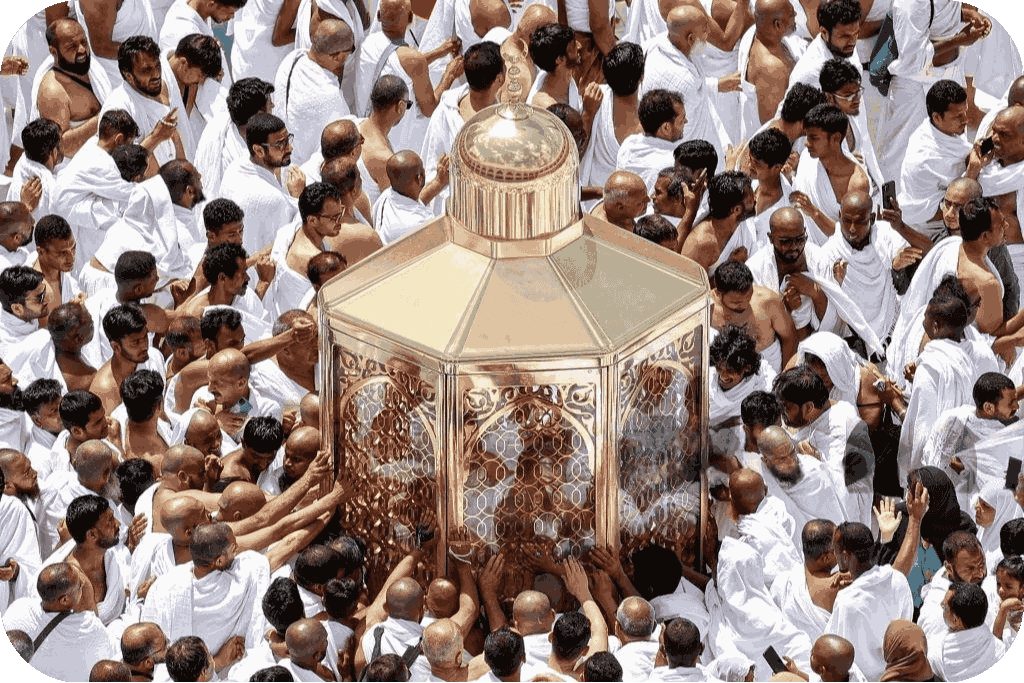
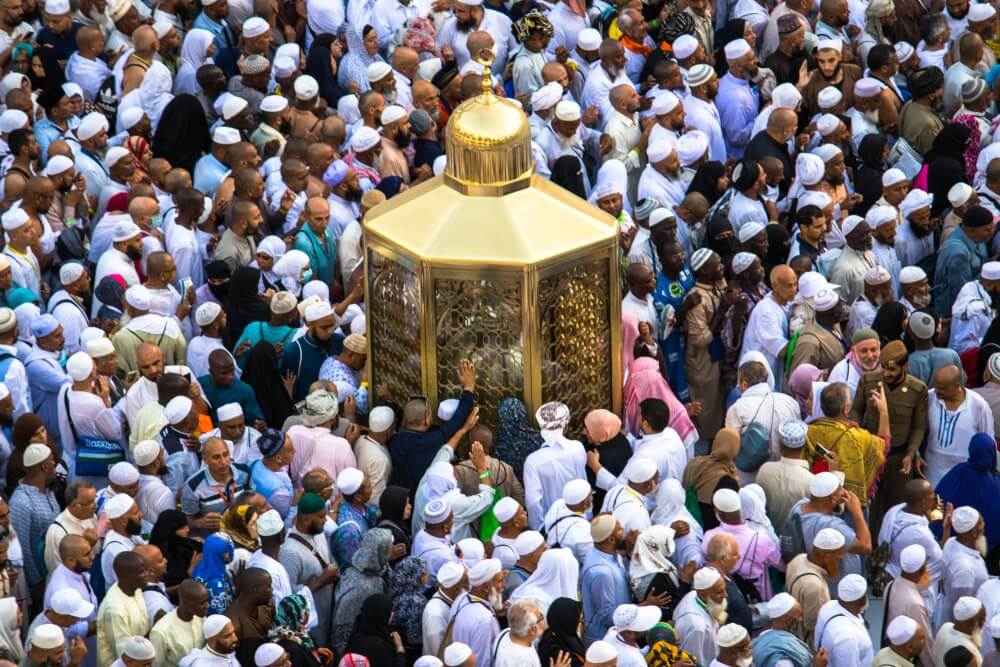
Within it are two oval foot imprints, deeper at the heels than the toes. Today, the original stone is fully encased for preservation. A gold-colored metal frame and thick crystal glass dome protect it while allowing visibility.
Importantly, the visible impressions on the outer casing are representative, not the exposed original stone itself.
Location of Maqam Ibrahim in Masjid al-Haram
Maqam Ibrahim is currently located:
- Approximately 10–11 meters east of the Kaaba
- Directly in the Mataf area, along the path toward Safa and Marwah
Originally, it stood closer to the Kaaba. During the caliphate of Umar ibn al-Khattab (RA), it was repositioned slightly to prevent obstruction during Tawaf—an action unanimously accepted by the companions.
Why Do Muslims Pray Behind Maqam Ibrahim?
After completing seven circuits of Tawaf, it is the Sunnah of the Prophet ﷺ to pray two rak‘ahs behind Maqam Ibrahim.
The Prophet ﷺ himself recited:
“And take the Station of Ibrahim as a place of prayer”
before offering these rak‘ahs.
Due to crowding, scholars clarify that:
- Praying anywhere behind the Maqam fulfills the Sunnah
- Direct proximity is not required
Recommended: Niyyah in Islam
What to Do at Maqam Ibrahim During Hajj or Umrah
Pilgrims should:
- Complete Tawaf
- Move calmly behind the Maqam
- Pray two rak‘ahs
- Recite Surah Al-Kafirun and Surah Al-Ikhlas if possible
There is no specific obligatory du‘a for this place, but sincere supplication is encouraged.
Historical Preservation Across Islamic Eras
Early Islamic Period
The Maqam remained uncovered during the Prophet’s time and early caliphates.
Abbasid and Ottoman Eras
- Gold and silver reinforcements were added after cracks appeared
- Domes and protective structures were introduced
- Annual coverings (sitara) were used for centuries
Saudi Era and Modern Enclosure
- Large obstructive buildings were removed
- A compact crystal dome was installed (1967)
- Further upgrades were completed during King Fahd’s era
The current design balances preservation, visibility, and crowd flow.
Common Misconceptions About Maqam Ibrahim
- Touching the Maqam for blessings has no basis in Sunnah
- The original stone is not directly exposed
- Its sanctity comes from divine command, not physical contact
Recommended: What Is Mustahabb?
FAQs
What is inside Maqam Ibrahim?
A sacred stone associated with Prophet Ibrahim’s standing place, preserved within a protective casing.
Why is Maqam Ibrahim important?
It is a Qur’an-affirmed sign, a Sunnah prayer location, and a direct link to the construction of the Kaaba.
Can you pray anywhere behind Maqam Ibrahim?
Yes. Scholars agree this fulfills the Sunnah, especially during crowds.
Is Maqam Ibrahim mentioned in the Qur’an?
Yes, explicitly in Surah Al-Baqarah (2:125) and Surah Aal-Imran (3:97).
Final Note
This article is entity-first, fact-verified, topically complete, and aligned with Koray Semantic SEO principles—built for long-term authority, not short-term ranking tricks.

Zeeshan is a professional driver and tour guide who has been living and driving in Saudi Arabia for the past 5 years. With deep knowledge of the roads, landmarks, and Ziyarat locations across Makkah, Madinah, Jeddah, and Taif, he helps pilgrims and travelers enjoy safe, smooth, and well-organized journeys. His experience in Umrah transport, city tours, and airport transfers makes him a trusted expert for visitors exploring Saudi Arabia.