


The Kaaba, located at the heart of Masjid al-Haram in Makkah, is the holiest structure in Islam and the spiritual focal point for Muslims worldwide. While millions perform Tawaf around it every year, very few ever see inside the Kaaba. Understanding what was—and is—inside the Kaaba requires historical, architectural, and religious context.
The Kaaba’s Purpose and Sacred Status

Known as Baytullah (House of Allah), the Kaaba determines the Qibla, the direction Muslims face during prayer. According to Islamic belief, it was originally established by Prophet Ibrahim and his son Ismail as a sanctuary dedicated solely to the worship of one God. Its interior, therefore, reflects shifts in religious history rather than decoration or symbolism alone.
Kaaba Inside Today
What Was Inside the Kaaba Before Islam
Before the advent of Islam, the Kaaba functioned as a central shrine for Arabian tribes. Over time, it became filled with idols, images, and offerings.
Key elements inside the Kaaba before Islam included:
- Around 360 idols, representing tribal deities
- The main idol Hubal, used for divination
- Painted images of angels, prophets, and sacred figures
- The horns of the ram associated with Ibrahim’s sacrifice
- A boycott document hung by Quraysh leaders
Although originally monotheistic, the Kaaba had become a repository of polytheistic worship by the time Prophet Muhammad ﷺ began his mission.
Recommended: Get Umrah Taxi
What Changed Inside the Kaaba After Islam
During the Conquest of Makkah, the Prophet Muhammad ﷺ ordered the complete purification of the Kaaba. All idols and images were removed, restoring it to its original monotheistic purpose.
After cleansing:
- The Kaaba was dedicated exclusively to the worship of Allah
- The Prophet ﷺ prayed inside the Kaaba
- Custodianship was entrusted to Banī Shaybah
- The Kaaba became a permanent Islamic sanctuary
This moment marked a decisive transformation in both function and meaning.
What Is Inside the Kaaba Today
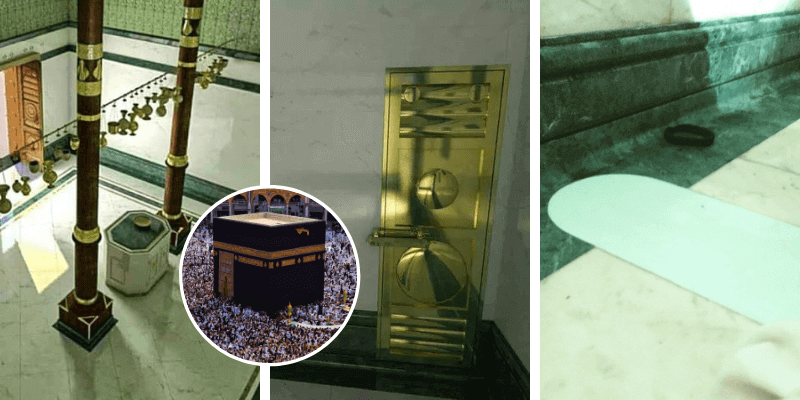
The interior of the Kaaba today is simple, dignified, and deeply symbolic, free from imagery or ornamentation meant for display.
Interior Structure and Materials
- White marble floor bordered with black marble
- Rose-colored marble walls up to 4 meters high
- Above the marble, green cloth embroidered with Quranic verses
- A ceiling lined with the same textile
Pillars and Structural Elements
- Three wooden pillars supporting the roof
- Each pillar stands approximately 9 meters high
- A staircase leads to the roof through Bab al-Tawbah (Door of Repentance)
Inscriptions and Historical Artefacts
- Ten marble plaques documenting restorations by Muslim rulers
- Scripts include Thuluth and Kufic calligraphy
- Ottoman-era lanterns and incense burners hang from the ceiling
Sacred Markers Inside the Kaaba
- Marked location where Prophet Muhammad ﷺ prayed
- Another marker near the Multazam commemorates his supplication
- A storage chest holds oud oil and Taif rose oil, used to perfume the Kaaba
Religious Practices Inside the Kaaba
Praying inside the Kaaba is permitted and was practiced by the Prophet ﷺ and his companions. Scholars differ on obligatory prayers:
- Voluntary prayers are unanimously allowed
- Obligatory prayers are permitted by some schools and discouraged by others
The Hijr Ismail, though outside the physical structure, is considered part of the Kaaba and holds the same ruling.
Cleaning and Maintenance of the Kaaba
The Kaaba is ceremonially cleaned twice a year. The process includes:
- Washing the interior with Zamzam water mixed with rose perfume
- Anointing the walls with oud
- Incensing the interior with silver burners
This ritual reflects reverence, not necessity, reinforcing the Kaaba’s sanctity.
Who Can Go Inside the Kaaba?
Access to the inside of the Kaaba is highly restricted.
Those permitted typically include:
- Custodians from Banī Shaybah
- Islamic scholars and dignitaries
- Heads of state and special guests
- Officials involved in cleaning and maintenance
Ordinary pilgrims are not allowed inside, making entry a rare honor.
7. FAQs
Q: Is the Black Stone inside the Kaaba?
No. The Black Stone is embedded in the eastern corner of the exterior.
Q: Is anything worshipped inside the Kaaba today?
No. The interior is empty of objects of worship, emphasizing pure monotheism.
Q: Can women enter the Kaaba?
Yes, but only if granted special permission, which is extremely rare.
Q: Is Hijr Ismail part of the Kaaba?
Yes. Praying there is equivalent to praying inside the Kaaba.

Zeeshan is a professional driver and tour guide who has been living and driving in Saudi Arabia for the past 5 years. With deep knowledge of the roads, landmarks, and Ziyarat locations across Makkah, Madinah, Jeddah, and Taif, he helps pilgrims and travelers enjoy safe, smooth, and well-organized journeys. His experience in Umrah transport, city tours, and airport transfers makes him a trusted expert for visitors exploring Saudi Arabia.