


The Jamarat Bridge is one of the most critical religious and engineering structures in the Islamic world. Located in Mina, near Makkah, Saudi Arabia, it serves as the designated site for performing Rami al-Jamarat, the symbolic stoning ritual that is an essential obligation of Hajj. Each year, millions of Muslim pilgrims pass through the bridge during a limited time window, making it a focal point where faith, logistics, and safety converge.
What Is the Jamarat Bridge?
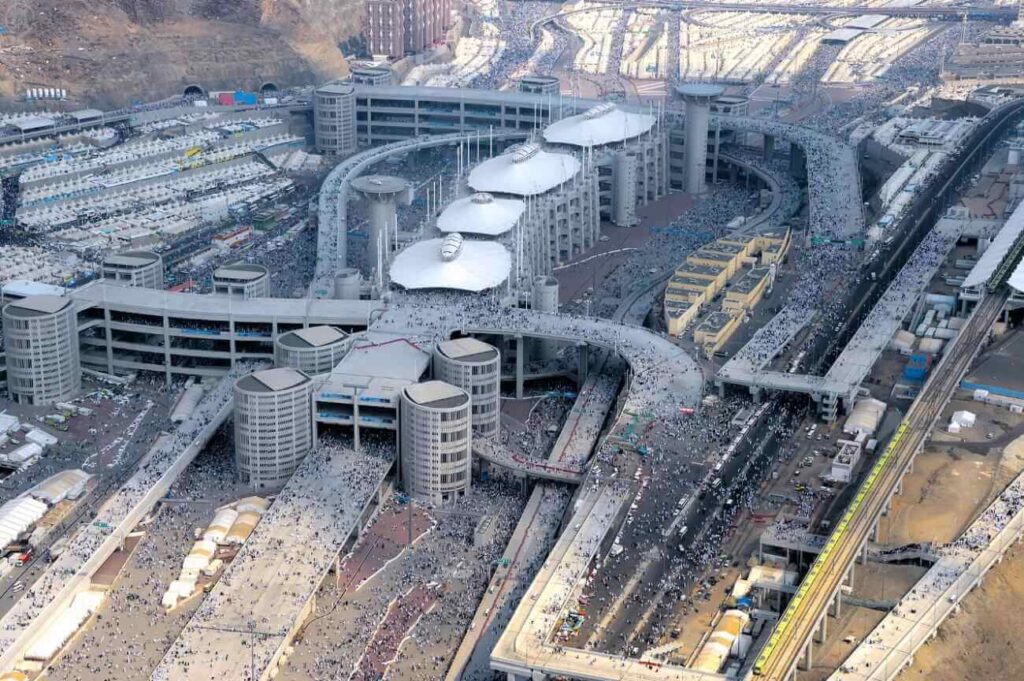
The Jamarat Bridge is a multi-level pedestrian complex built specifically to facilitate the safe performance of the stoning ritual during Hajj. Pilgrims throw small pebbles at three stone structures representing Shaitan (Satan), following the Sunnah of Prophet Ibrahim (peace be upon him). Unlike ordinary bridges, the Jamarat Bridge is designed entirely around crowd control, ritual flow, and religious compliance, ensuring pilgrims can perform the rite without physical danger or obstruction.
Recommended: Jeddah to Makkah Taxi
Religious Background of Rami al-Jamarat
The ritual of Rami al-Jamarat commemorates the moment when Prophet Ibrahim (AS) was tested by Allah and repeatedly tempted by Satan to disobey the divine command. Ibrahim rejected these temptations by throwing stones, an act that symbolizes resistance against evil, ego, and disobedience.
Pilgrims throw seven pebbles at each Jamrah, following the prophetic tradition. The number seven carries religious consistency within Islamic worship and represents completion and obedience rather than aggression. The ritual begins on the 10th of Dhul-Hijjah and continues until the 13th, marking the final phase of the Hajj pilgrimage.
The Three Jamarat Pillars Explained
The Jamarat consist of three distinct pillars aligned in sequence within Mina:
Jamarat al-Sughra (Small Jamrah)
This represents the first temptation faced by Prophet Ibrahim.
Jamarat al-Wusta (Middle Jamrah)
Symbolizes the second rejection of Satan’s influence.
Jamarat al-Kubra (Largest Jamrah)
Also known as Jamrat al-Aqabah, it is the most significant and the primary focus on the first day of stoning.
The spacing between these pillars is intentionally designed, with approximately 135 meters between the first and second, and 225 meters between the second and third, allowing regulated movement and ritual order.
Geographic Location and Setting
The Jamarat Bridge is situated within the Mina Valley, around 6–8 kilometers southeast of Makkah, at an elevation of approximately 400 meters. Mina itself spans nearly 20 square kilometers and transforms annually into the world’s largest temporary city, housing more than three million pilgrims in over 100,000 air-conditioned tents.
The bridge integrates seamlessly into Mina’s infrastructure, connecting pedestrian routes from all major pilgrim directions, including Makkah, Muzdalifah, and central Mina.
Evolution and History of the Jamarat Bridge
The first version of the Jamarat Bridge was built in 1963 as a simple, single-level crossing. As global Muslim populations increased, the structure became insufficient for the scale of modern Hajj. Several tragic stampedes occurred over the decades, highlighting severe limitations in crowd handling and safety.
Following major incidents in the early 2000s, Saudi authorities initiated a complete demolition and reconstruction project between 2006 and 2009, transforming the bridge into a modern, multi-level pilgrimage complex designed specifically to eliminate crowd convergence and bottlenecks.
Modern Architectural Design and Engineering
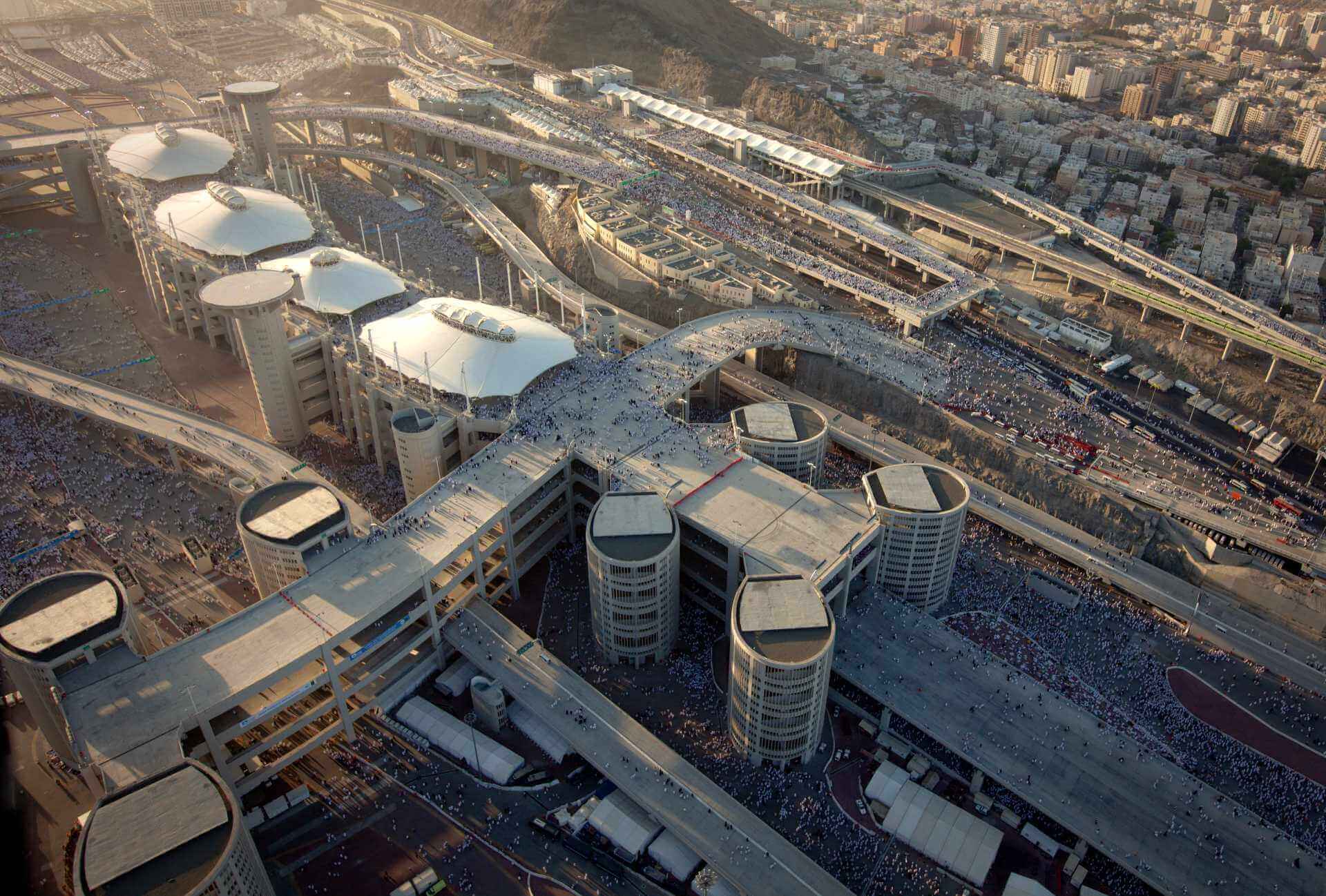
The current Jamarat Bridge stretches approximately 950 meters in length and 80 meters in width, comprising five operational levels plus a service basement. Each level stands around 12 meters high, allowing vertical separation of pilgrim movement.
The structure uses precast, post-tensioned concrete, enabling wide, column-free spans of up to 100 meters, ensuring clear visibility and uninterrupted ritual performance. The pillars were redesigned from circular columns into elongated oval walls, dramatically improving pedestrian flow and reducing pressure points.
The project was designed by Dar Al-Handasah and constructed by leading Saudi engineering firms, reflecting one of the largest crowd-management projects ever executed.
Safety, Capacity, and Crowd Management
The Jamarat Bridge can safely handle up to 300,000 pilgrims per hour, with a total operational capacity exceeding 3–5 million pilgrims during peak stoning periods. Its foundations are engineered for future expansion up to 12 levels if required.
Key safety features include:
- 11 controlled entrances and 12 exits distributed across different levels
- Directional routing that prevents opposing pedestrian flows
- Heat-reduction mist cooling systems maintaining temperatures near 29°C
- Emergency evacuation routes, medical points, and helipads
These measures collectively transformed the Jamarat area from one of Hajj’s most dangerous locations into one of its safest.
Importance of the Jamarat Bridge in Modern Hajj
Today, the Jamarat Bridge stands as a symbol of how religious tradition and modern engineering can coexist. It preserves the exact religious requirements of the stoning ritual while applying advanced crowd science, structural engineering, and urban planning.
Without the Jamarat Bridge, managing the spiritual obligations of millions of pilgrims within a few days would be nearly impossible. Its existence ensures that the Hajj remains accessible, safe, and spiritually intact for future generations.
FAQs
What is the Jamarat Bridge used for?
It is used exclusively for performing the Rami al-Jamarat ritual during Hajj.
Why do pilgrims throw stones at the Jamarat?
To symbolize rejecting Satan and following the obedience of Prophet Ibrahim (AS).
How many levels does the Jamarat Bridge have?
Currently five operational levels, with structural capacity for future expansion.
Where is the Jamarat Bridge located?
In Mina Valley, near Makkah, Saudi Arabia.

Zeeshan is a professional driver and tour guide who has been living and driving in Saudi Arabia for the past 5 years. With deep knowledge of the roads, landmarks, and Ziyarat locations across Makkah, Madinah, Jeddah, and Taif, he helps pilgrims and travelers enjoy safe, smooth, and well-organized journeys. His experience in Umrah transport, city tours, and airport transfers makes him a trusted expert for visitors exploring Saudi Arabia.