


Riyadh International Airport is the common name travelers use for King Khalid International Airport (RUH), the official gateway to Saudi Arabia’s capital. If you’re flying in for business, a stopover, or continuing your journey toward Makkah or Madinah, the airport has just been through the biggest change in its 40-year history – and knowing what’s changed can save you real time and stress.
Riyadh’s main airport is King Khalid International Airport (IATA: RUH), located about 35 km north of the city center. As of February 2026, its five terminals were reorganized: Terminals 1 and 2 now handle international and national carriers, Terminals 3 and 4 handle all domestic flights, and Terminal 5 serves foreign international airlines. The fastest way into the city is the Riyadh Metro Yellow Line (around 35 minutes, SAR 4); a taxi takes roughly 30–45 minutes and costs SAR 50–100.
This guide walks through everything you need – terminals, transport options, visa rules, amenities, and what to do if Riyadh is only the first leg of a longer trip to the Two Holy Mosques.
What Airport Serves Riyadh?
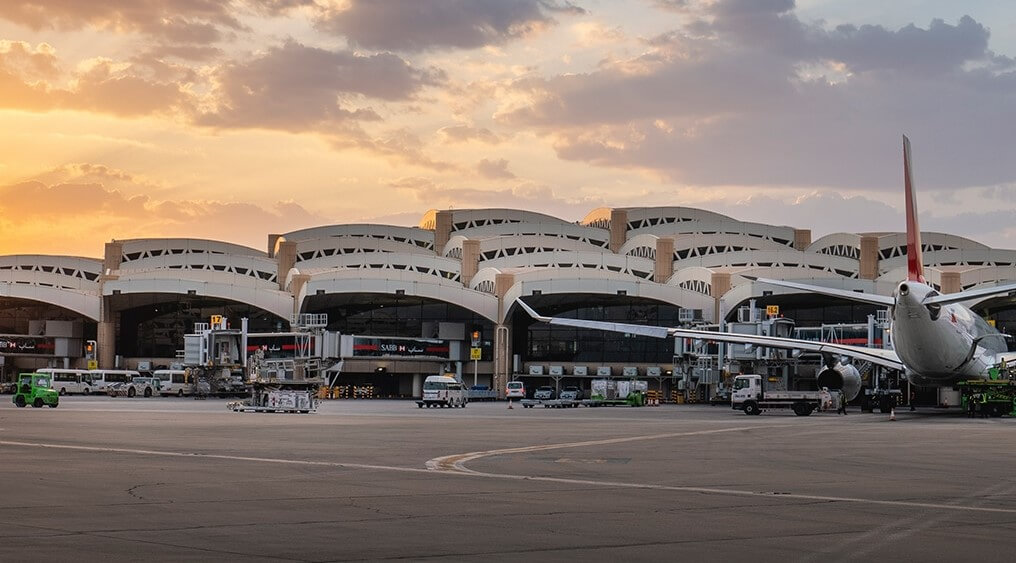
King Khalid International Airport, commonly abbreviated KKIA, is Saudi Arabia’s second-busiest airport and the primary gateway to Riyadh. It opened on 16 November 1983 under King Fahd and was named after King Khalid bin Abdulaziz Al Saud. The site spans an enormous footprint – one of the largest airport land areas in the world – and its terminal buildings are arranged in a distinctive triangular layout around a central mosque.
The airport is operated by Riyadh Airports Company and sits roughly 35 kilometers north of downtown Riyadh, close to at least a 30-minute drive under normal traffic. It’s a hub for Saudia and flynas, and a growing base for Saudi Arabia’s newer national carrier, Riyadh Air, alongside international operators such as Emirates, Qatar Airways, Turkish Airlines, and Lufthansa.
A note on naming: you’ll see the airport called “Riyadh Airport,” “Riyadh International Airport,” and “King Khalid International Airport” interchangeably online and in casual conversation. They all refer to the same facility (RUH). A separate, much larger facility – King Salman International Airport – is under long-term development as Riyadh’s future mega-hub, but as of 2026 all scheduled commercial flights continue to operate through King Khalid, with no confirmed date yet for a full transfer of operations.
The February 2026 Terminal Reshuffle: What Changed
If you’ve flown through Riyadh before, don’t rely on your memory of which terminal your airline used. Between 16 and 25 February 2026, Riyadh Airports Company carried out a sweeping ten-day terminal reallocation that moved most airlines to new locations, even where flight numbers stayed the same.
The current layout is:
- Terminals 1 and 2 – international and national carrier operations, including Saudia and the newly launched Riyadh Air, plus flynas and flyadeal’s international routes. Terminal 1 was fully renovated and reopened in December 2024 with modern check-in counters, automated e-gates, and expanded retail.
- Terminals 3 and 4 – now handle all domestic flights. Terminal 3 was previously the main hub for foreign international carriers but was reassigned to domestic operations under the 2026 plan. It still offers duty-free, dining, banking, and an on-site medical clinic.
- Terminal 5 – serves foreign international airlines. It operates largely as a standalone terminal, connected to the others by a free shuttle bus running every 10–15 minutes.
Practical takeaway: always verify your terminal on your boarding pass, your airline’s app, or through the airport’s official WhatsApp confirmation line before you travel – not from a previous trip or an outdated blog post.
Riyadh Metro Access by Terminal
The Riyadh Metro Yellow Line now serves the airport with terminal-specific stations:
- Terminals 1 and 2 – Station 20 (the line’s final stop)
- Terminals 3 and 4 – Station 19
- Terminal 5 – Station 18
The metro is generally the fastest and cheapest way to reach central Riyadh, taking about 35 minutes for a fare of roughly SAR 4.
Recommended: Riyadh to Makkah Taxi
Getting To and From Riyadh Airport
You have four realistic options for reaching the city or your onward destination:
Riyadh Metro (Yellow Line): The cheapest and often fastest option at peak traffic times, connecting directly to King Abdullah Financial District (KAFD) and central Riyadh stations.
Taxi: Widely available outside all terminals, with fares typically running SAR 50–100 depending on your destination and time of day, and a journey time of 30–45 minutes.
Ride-hailing apps (Uber, Careem): Popular with both residents and visitors, offering upfront pricing and easy pickup coordination through the app.
Private chauffeur / pre-booked transfer: The most comfortable option for families, business travelers, or anyone arriving with heavy luggage, especially late at night or during peak Hajj and Umrah travel periods when demand for on-the-spot taxis spikes. A pre-booked driver eliminates the uncertainty of curbside queues and lets you track your flight and adjust pickup timing automatically.
Parking: For self-drivers, the airport offers ParkSHORT and ParkLONG (from SAR 10/hour) and a valet option (ParkVALET) at Terminals 2 through 5 for SAR 115 per vehicle.
Immigration, Visas, and Biometric Gates
Most nationalities can enter Saudi Arabia on a tourist e-visa, and 2026 has seen the full rollout of biometric e-gates for arrivals. First-time visitors typically need to clear a manual immigration counter once to register their biometrics; after that, returning visitors can generally use the automated gates for faster processing. There’s no exit visa requirement for tourists – departure is a straightforward pass through passport control with your boarding pass.
Arrival timing tip: Saudia and Riyadh Air recommend arriving at least 3 hours before international departures and 2 hours before domestic flights. During Hajj and Umrah travel peaks – especially through the Ramadan period and the months leading into the Hajj season – build in extra buffer time, as security and check-in queues lengthen considerably.
Amenities, Accessibility, and Comfort
King Khalid International Airport functions as a full lifestyle hub rather than a pure transit point:
- Dining: A mix of Saudi hospitality brands and international chains, including Al Baik, Shake Shack, and dedicated Arabic coffee lounges.
- Duty-free: Riyadh Duty Free operates in Terminals 1, 2, 3, 4, and 5, alongside Al Waha, the first Saudi-owned duty-free brand, offering dates, camel-milk chocolates, and local artisanal gifts.
- Lounges: Several pay-per-use and airline lounges are spread across the terminals, including a Plaza Premium Lounge in Terminal 1 accommodating up to 210 guests.
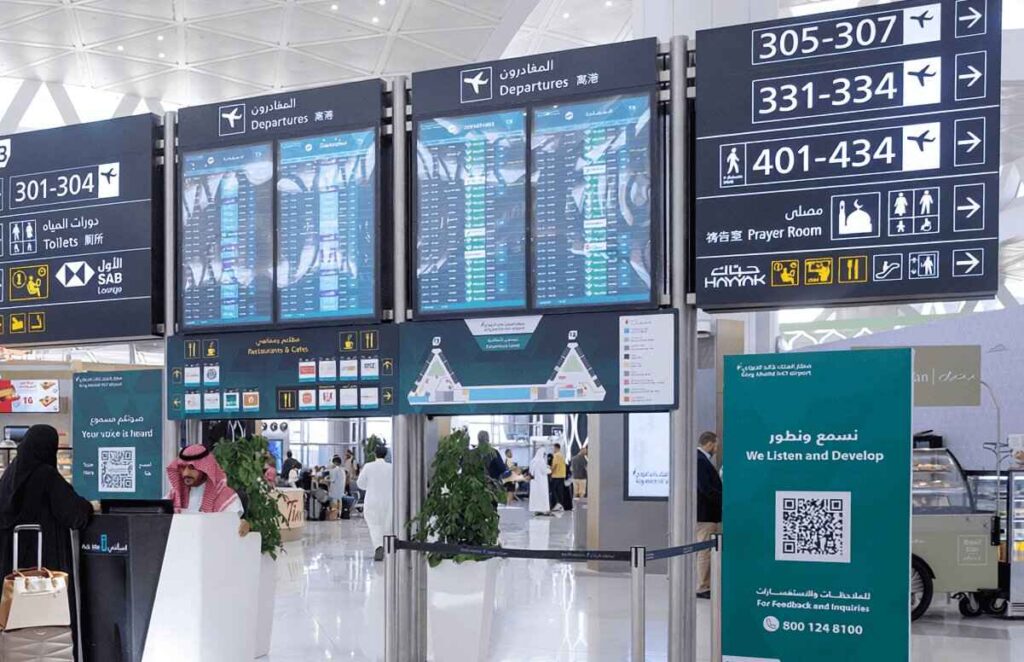
- Prayer and quiet spaces: Multi-faith prayer rooms and dedicated quiet zones are standard across all concourses, alongside the airport’s own grand mosque.
- Accessibility: As a People of Determination-friendly airport, KKIA runs a Sunflower Lanyard program for travelers with non-visible disabilities, offers free wheelchair assistance (48 hours’ notice recommended for guaranteed availability), and maintains sensory rooms in Terminals 3 and 5 for children and adults with sensory processing needs. Dedicated “Silver Service” teams also assist senior travelers with navigation and baggage.
- Families: Nursing rooms, diaper-changing stations, and family restrooms are available in all terminals.
- Medical and banking: Al Habib Hospital Clinic operates in Terminals 3 and 4, with a separate clinic in Terminal 5. ATMs and currency exchange are available throughout, including multilingual options.
Continuing Your Journey: Riyadh to Makkah or Madinah
For a significant number of travelers – pilgrims arriving on a combined itinerary, business visitors extending their trip, or families visiting relatives before continuing to Umrah – Riyadh is only the first stop of a longer journey west. This is where planning your onward transport matters as much as the flight itself.
By private car (recommended for comfort and flexibility): The overland route from Riyadh to Makkah covers roughly 880–900 km and typically takes 8 to 10 hours by road, while Riyadh to Madinah covers a similar distance at around 7 to 8 hours, depending on traffic, rest stops, and time of departure. A private intercity taxi lets you set your own schedule, travel with your full luggage without airline restrictions, and take breaks for prayer and meals along the way – something a fixed-schedule bus or connecting flight can’t offer.
By connecting flight: Domestic flights from Riyadh to Jeddah take about 90 minutes, after which you’ll still need ground transportation to reach Makkah. This route can be faster overall but adds a second security and boarding process, plus the extra coordination of arranging transfer at the second airport.
By bus: SAPTCO operates scheduled intercity coaches, generally the cheapest option but with journey times exceeding 13 hours and fixed departure windows that don’t adjust to flight delays.
Why travelers choose a private intercity transfer: For pilgrims heading into Ihram, families with children, or anyone arriving tired after a long-haul flight, a private vehicle with a professional, licensed driver removes the guesswork of connecting flights and public transit schedules. This is precisely the kind of route Al Maqam Transport specializes in – private intercity taxi service connecting Saudi Arabia’s major cities, with vehicle options ranging from a comfortable Toyota Camry for individuals and couples to a Hyundai Staria, Toyota Hiace, or GMC Yukon for families and small groups, and a Coaster bus for larger parties. If your trip from Riyadh continues on to Makkah or Madinah, arranging a private intercity taxi in advance means your driver can track your flight, adjust for delays, and take you directly to your hotel near Masjid al-Haram or Masjid an-Nabawi without a mid-journey transfer.
Best Times to Travel Through Riyadh Airport
Riyadh Airport sees its heaviest passenger volumes during three overlapping periods: the lead-up to Hajj season, the Ramadan and Umrah travel surge, and major domestic events like Riyadh Season, which draw large numbers of international visitors. During these windows:
- Book your onward intercity transport in advance rather than arranging it on arrival.
- Expect longer immigration and security queues, and add extra buffer time beyond the standard 2–3 hour recommendation.
- If you’re arriving specifically for Umrah or Hajj, confirm your pilgrim documentation and any group transport arrangements before you land, since demand for taxis and private vehicles spikes sharply during these seasons.
Nearby Attractions If You Have Time in Riyadh
Travelers with a layover or a short stay before continuing their journey often use the time to visit Diriyah, the historic birthplace of the Saudi state and a UNESCO World Heritage Site with restored mud-brick palaces and fortifications, or the National Museum of Saudi Arabia in the King Abdulaziz Historical Center. Both are within a reasonable taxi ride of the airport and offer a meaningful introduction to the country’s history for anyone new to Saudi Arabia.
FAQs
What is Riyadh International Airport actually called?
Its official name is King Khalid International Airport (IATA code: RUH). “Riyadh International Airport” and “Riyadh Airport” are the common names people use for the same facility.
How far is the airport from central Riyadh?
About 35 kilometers, roughly a 30–45 minute drive depending on traffic and route.
Which terminal does my airline use in 2026?
Following the February 2026 reallocation, Terminals 1 and 2 handle international and national carriers, Terminals 3 and 4 handle all domestic flights, and Terminal 5 serves foreign international airlines. Always confirm on your boarding pass or airline app, since assignments changed for almost every carrier.
Can I walk between terminals?
Terminals 1 and 2 are connected and share a metro station. Movement to and from Terminal 5, and some newer gate configurations, generally requires the free shuttle bus, which runs every 10–15 minutes.
Is there a metro connection to the airport?
Yes. The Riyadh Metro Yellow Line serves the airport directly, with dedicated stations for Terminals 1–2, 3–4, and 5.
Do I need a visa to enter Saudi Arabia through Riyadh?
Most travelers need a tourist e-visa or visa on arrival; eligibility varies by nationality. Biometric e-gates are now widely available for returning visitors after an initial manual registration.
How much does a taxi from the airport to the city cost?
Typically SAR 50–100 for a standard taxi into central Riyadh, though pre-booked private transfers may price differently based on vehicle type and distance.
How long does it take to drive from Riyadh to Makkah?
Around 8 to 10 hours by road, covering roughly 880–900 kilometers, depending on traffic, time of departure, and rest stops.
How long does it take to drive from Riyadh to Madinah?
Approximately 7 to 8 hours by road.
Is it better to fly or drive from Riyadh to Makkah or Madinah?
Flying to Jeddah and then transferring by road can be faster overall, but it adds a second airport process and a transfer coordination step. Driving directly by private car is often more comfortable for families, pilgrims preparing for Ihram, or travelers with heavy luggage, since it avoids connecting-flight logistics entirely.
What’s the best way to arrange transport for Hajj or Umrah pilgrims arriving via Riyadh?
Book your intercity private taxi in advance of your travel dates, particularly during Ramadan and the months leading up to Hajj, when demand for vehicles rises sharply and last-minute availability becomes limited.
Are there family-friendly vehicle options for group travel?
Yes. For intercity routes, options typically include spacious vans such as the Toyota Hiace or Hyundai Staria, SUVs like the GMC Yukon, and coach buses for larger groups, in addition to standard sedans for individuals or couples.
Does the airport have prayer facilities?
Yes. Multi-faith prayer rooms are available in every terminal, and the airport has its own grand mosque, accessible by shuttle.
What accessibility services are available at the airport?
Free wheelchair assistance (48 hours’ notice recommended), a Sunflower Lanyard program for travelers with non-visible disabilities, sensory rooms in Terminals 3 and 5, and dedicated support teams for senior travelers.
When is the busiest time to travel through Riyadh Airport?
The periods surrounding Hajj season, the Ramadan and Umrah travel surge, and major domestic events such as Riyadh Season see the heaviest passenger volumes and longer processing times.

Zeeshan is a professional driver and tour guide who has been living and driving in Saudi Arabia for the past 5 years. With deep knowledge of the roads, landmarks, and Ziyarat locations across Makkah, Madinah, Jeddah, and Taif, he helps pilgrims and travelers enjoy safe, smooth, and well-organized journeys. His experience in Umrah transport, city tours, and airport transfers makes him a trusted expert for visitors exploring Saudi Arabia.