


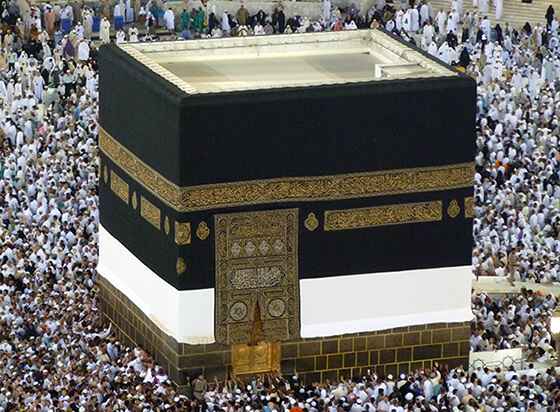
Al-Kaaba, located at the heart of Masjid al-Haram in Makkah, is the most sacred structure in Islam and the spiritual axis of the Muslim world. Known as Baytullah (the House of Allah), the Kaaba is not revered for its physical form alone, but for its divine purpose as the first place established for the worship of Allah.
Every day, millions of Muslims across continents face the Kaaba during prayer, and each year, millions more gather around it to perform Hajj and Umrah, fulfilling rituals that trace back to Prophet Ibrahim (peace be upon him).
What Is Al-Kaaba and Why It Matters in Islam?
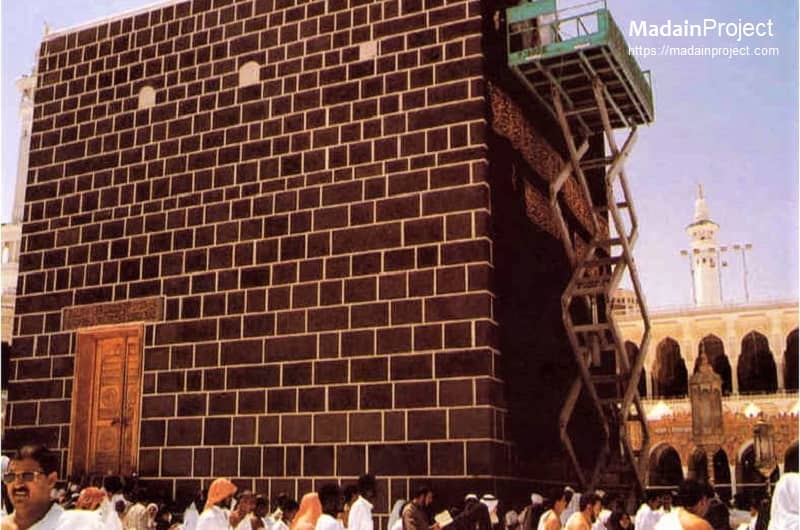
The Kaaba serves as the Qibla, the unified direction of prayer for all Muslims, symbolizing unity, obedience, and monotheism. Muslims do not worship the Kaaba itself; rather, they worship Allah while facing it as a commandment from Him.
The Qur’an highlights its central role:
“Allah has made the Ka‘bah, the Sacred House, a means of support for people.” (Surah Al-Ma’idah 5:97)
This verse establishes the Kaaba as a spiritual anchor for humanity, not merely a building but a divinely appointed focal point.
Location of the Kaaba Inside Masjid al-Haram
Al-Kaaba stands at the center of Masjid al-Haram, the Grand Mosque of Makkah. The open white marble area surrounding it, known as the Mataf, is where pilgrims perform Tawaf, circling the Kaaba seven times in a counter-clockwise direction.
Access to Makkah and Masjid al-Haram is restricted to Muslims only, preserving the sanctity of the holy city.
Physical Structure and Dimensions of Al-Kaaba
Despite its global importance, the Kaaba is architecturally simple, emphasizing humility and devotion rather than grandeur.
The structure is a rectangular cuboid, not a perfect cube. Its height is approximately 13 to 15 meters, with sides measuring roughly 11 and 12.8 meters. The building is constructed from local stone and rests on a slightly raised marble base.
The four corners of the Kaaba align closely with the cardinal directions, giving each corner religious significance, including the Rukn al-Yamani and the corner containing the Black Stone.
External Architectural Elements of the Kaaba
The Bab al-Kaaba, a solid gold door installed in the modern era, is located on the eastern wall and elevated above ground level. This elevation dates back to the Quraysh reconstruction to control access.
Embedded in the eastern corner is Hajar al-Aswad (the Black Stone), marking the starting point of Tawaf. Pilgrims attempt to kiss or touch it, following the Sunnah of the Prophet Muhammad ﷺ.
Running along the base of the Kaaba is the Shadherwan, a sloped marble ledge protecting the foundation. On the roof’s northern side extends the Mizab al-Rahmah, a gold rainwater spout that drains into Hijr Ismail.
The Kiswah – Covering of the Kaaba
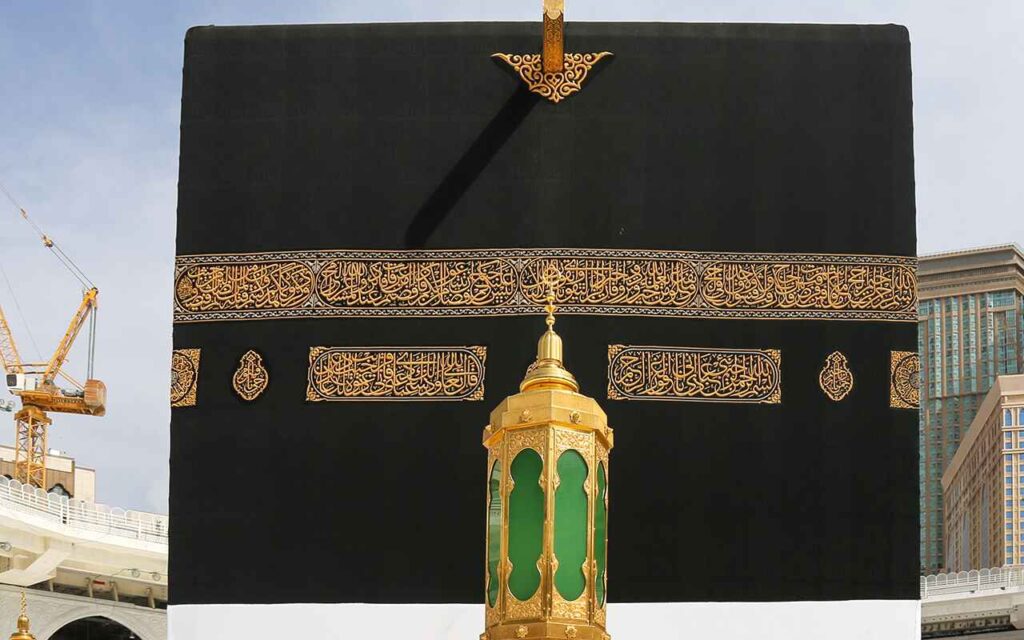
The Kaaba is draped in the Kiswah, a black silk cloth embroidered with Qur’anic verses in gold and silver thread. It is produced annually and replaced during the Hajj season, symbolizing renewal and honor. Historically, various Muslim rulers contributed to its production, and today it is crafted in a dedicated Kiswah factory in Makkah.
Sacred Areas Connected to the Kaaba
Adjacent to the Kaaba is Hijr Ismail (Hateem), a semi-circular low wall that marks part of the original foundation laid by Prophet Ibrahim. Prayer inside this area carries the same reward as praying inside the Kaaba itself.
Nearby stands Maqam Ibrahim, a stone bearing the footprints of Prophet Ibrahim, where pilgrims pray after completing Tawaf, following Qur’anic instruction.
Interior of the Kaaba
The interior of the Kaaba is simple and serene. It features marble flooring, marble-clad walls, and three wooden pillars supporting the roof. Hanging lamps and inscriptions adorn the upper walls. Entry inside the Kaaba is extremely rare and reserved for special cleaning ceremonies attended by select individuals.
Historical Construction and Reconstructions of the Kaaba
Islamic tradition holds that the Kaaba was first established by Prophet Adam, later rebuilt by Prophet Ibrahim and his son Ismail on divine command. Over centuries, it underwent multiple reconstructions due to floods and structural wear.
The Quraysh rebuilding (605 CE) introduced a roof, raised door, and left Hijr Ismail outside due to limited lawful funds. Later reconstructions by Abdullah ibn Zubair, Hajjaj ibn Yusuf, Ottoman Sultan Murad IV, and modern Saudi authorities preserved its form while strengthening its structure.
The last major internal renovation occurred in 1995 during the reign of King Fahd, ensuring long-term preservation.
Spiritual Role of the Kaaba in Hajj and Umrah
The Kaaba is central to Hajj and Umrah rituals, especially Tawaf. Performing Tawaf represents complete submission to Allah, mirroring the worship of angels around Baytul Ma’moor, the heavenly counterpart of the Kaaba.
Pilgrims often describe their first sight of the Kaaba as spiritually overwhelming, a moment that defines their journey.
Visiting the Kaaba – Rules, Access, and Experience
While Masjid al-Haram remains open year-round, access to the Kaaba’s interior is restricted. For those unable to visit, official 24/7 live broadcasts allow Muslims worldwide to remain spiritually connected.
Traveling to the Kaaba for Umrah and Hajj
For pilgrims arriving in Makkah, comfortable and reliable transport is essential. Many visitors choose private Umrah taxi services for airport transfers, hotel transport, and intercity travel between Makkah, Madinah, Jeddah, and holy sites. Using a dedicated Umrah and Hajj taxi service ensures timely arrivals, peace of mind, and focus on worship rather than logistics.
The Kaaba in Islamic Belief and the End of Times
Authentic hadiths indicate that the Kaaba will be destroyed near the end of time, marking a profound shift in human history. This underscores that while the structure is sacred, its purpose is to guide humanity toward Allah-not to exist eternally as stone.
Conclusion
Al-Kaaba is the spiritual heart of Islam, uniting believers across geography, language, and culture. Its simplicity, deep history, and central role in worship embody the essence of Islamic monotheism. Whether viewed from afar, visited during Umrah, or circumambulated during Hajj, the Kaaba remains a timeless symbol of faith, unity, and devotion.
FAQs
What is Al-Kaaba made of?
The Kaaba is built from local stone and marble, reinforced and maintained through centuries of renovations.
Why do Muslims face the Kaaba during prayer?
Facing the Kaaba fulfills Allah’s command and symbolizes unity in worship.
Can non-Muslims enter Makkah or see the Kaaba?
No, access to Makkah and Masjid al-Haram is restricted to Muslims only.
Is Hijr Ismail part of the Kaaba?
Yes, it is considered part of the original foundation built by Prophet Ibrahim.
How often is the Kiswah changed?
The Kiswah is replaced once every year during the Hajj season.

Zeeshan is a professional driver and tour guide who has been living and driving in Saudi Arabia for the past 5 years. With deep knowledge of the roads, landmarks, and Ziyarat locations across Makkah, Madinah, Jeddah, and Taif, he helps pilgrims and travelers enjoy safe, smooth, and well-organized journeys. His experience in Umrah transport, city tours, and airport transfers makes him a trusted expert for visitors exploring Saudi Arabia.