


Jabal Abu Qubais (Arabic: جبل أبو قبيس) stands as one of the most sacred and historically layered mountains in Makkah, located immediately to the east of Masjid al-Haram, rising above Safa Hill. Although much of its original form has been absorbed into modern development, its spiritual presence remains deeply embedded in Islamic memory, Qur’anic history, and prophetic tradition.
This mountain is not simply a geographical landmark. It is directly connected to foundational moments of Islam, from the earliest human history to the final Messenger ﷺ, making it one of the most meaningful sites surrounding the Sacred Mosque.
Jabal Abu Qubais Location and Physical Context
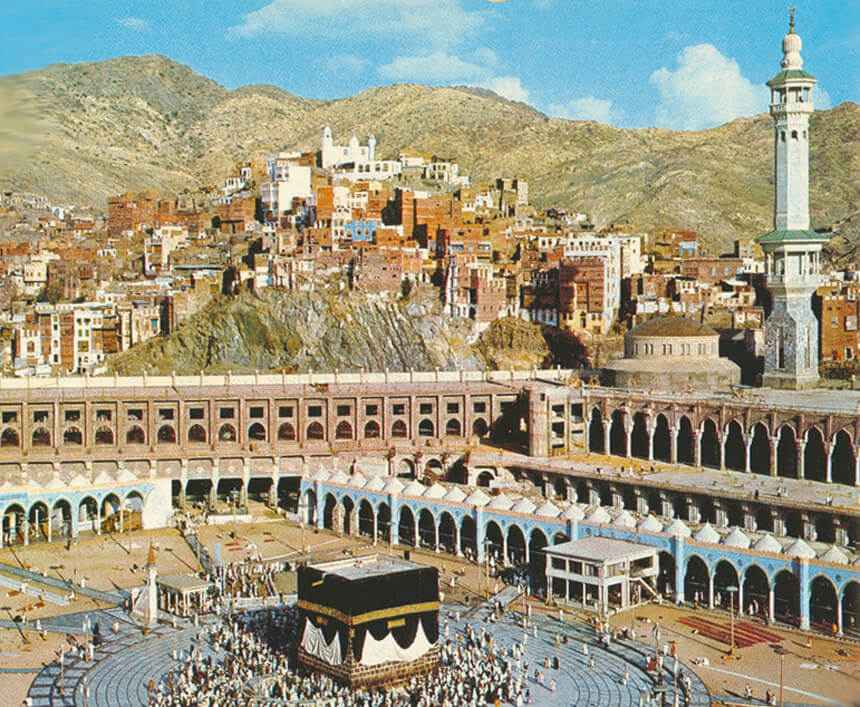
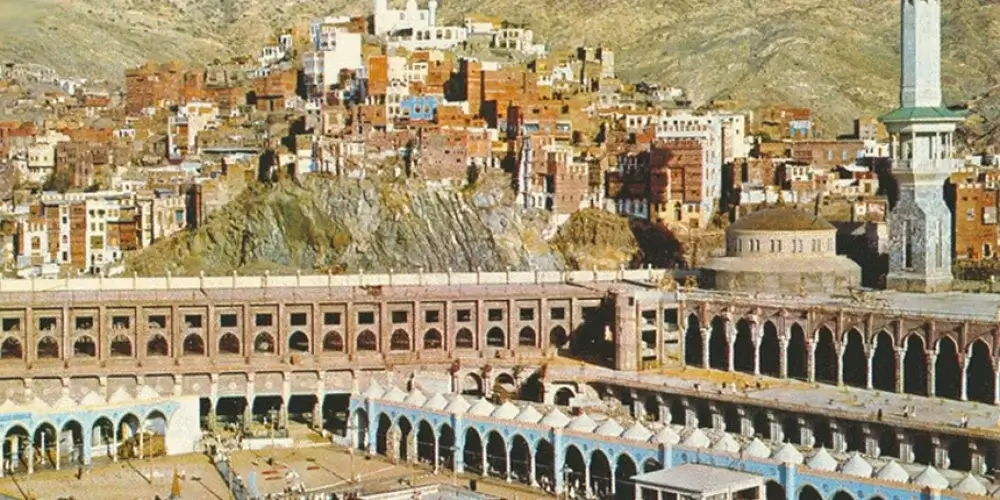
Jabal Abu Qubais overlooks the eastern boundary of the Haram, directly adjacent to Jabal al-Safa, where the ritual of Sa‘i begins. Historically, it stood as the closest mountain to the Kaaba, at a distance of roughly one hundred meters, rising to an elevation of approximately 420 meters above sea level.
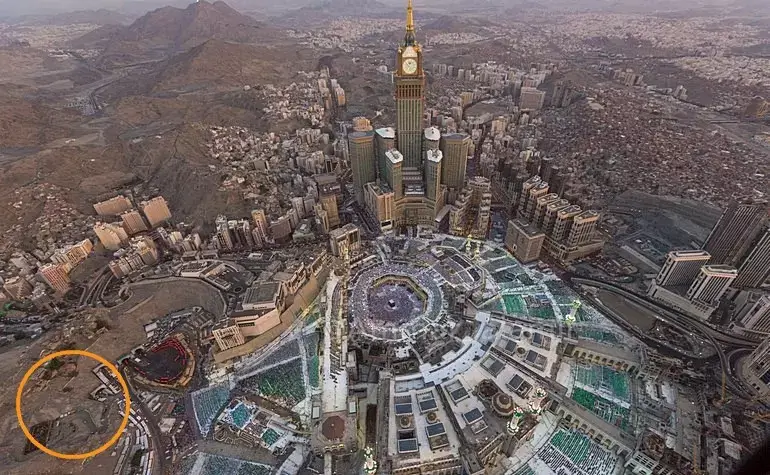
Today, due to the continuous expansion of Masjid al-Haram and the urban growth of Makkah, the mountain is largely integrated into modern structures. Nevertheless, when standing at Safa and looking outward from the Mas‘a area, pilgrims are still facing Jabal Abu Qubais.
Names and Early Identity of Jabal Abu Qubais
The name “Abu Qubais” has multiple explanations found in early Hijazi traditions. Some link it to a man or ruler from ancient Arabia, while others consider these accounts folkloric rather than historical. What carries greater religious weight is its older and more widely recognized name: Al-Amin (The Trustworthy).
It was given this title because, according to Islamic tradition, the mountain safeguarded the Hajar al-Aswad (Black Stone) during the Great Flood in the time of Prophet Nuh (AS), preserving it until Allah commanded that it be returned to its place in the Kaaba.
Religious and Historical Significance
The First Mountain on Earth
Early Makkan historians such as al-Azraqi report that Jabal Abu Qubais was the first mountain placed upon the earth, anchoring the land before other mountains were formed. This belief elevated its status among the natural landmarks of Makkah long before Islam.
Safeguarding the Black Stone
Multiple classical narrations state that when the flood of Prophet Nuh (AS) covered the earth, the Black Stone was placed within Jabal Abu Qubais for protection. Later, when Prophet Ibrahim (AS) rebuilt the Kaaba with his son Ismail (AS), the stone was retrieved and placed in its designated position, reconnecting the mountain directly to the structure of the Sacred House.
The Miracle of the Splitting of the Moon
Perhaps the most famous event associated with Jabal Abu Qubais is the miracle of Shaqq al-Qamar. When the Quraysh demanded a sign of prophethood, Prophet Muhammad ﷺ pointed toward the moon, and by Allah’s command, it split into two distinct parts.
Authentic narrations report that one part appeared over Jabal Abu Qubais, while the other was seen beyond the mountain. This event is referenced in the opening verses of Surah al-Qamar and was witnessed by companions such as Abdullah ibn Mas‘ud (RA), making the mountain a permanent symbol of prophetic truth.
Prophet Ibrahim’s Call to Hajj
After completing the construction of the Kaaba, Prophet Ibrahim (AS) was commanded by Allah to proclaim the call to Hajj. Standing upon Jabal Abu Qubais – or Safa according to some narrations – he called humanity to pilgrimage, and Allah caused his voice to reach every soul destined to answer that call until the end of time.
This connection places the mountain at the very heart of the Hajj tradition that continues uninterrupted today.
Adam and the Earliest Human History
Some early historians mention that Prophet Adam (AS) descended near Jabal Abu Qubais and worshipped Allah there. Reports also exist suggesting his burial in the vicinity of the mountain, though scholars caution that no definitive location of his grave is established. These narrations, while not doctrinal, reflect the mountain’s perceived sanctity in early Islamic thought.
Role in Early Islamic and Political History
Following the Conquest of Makkah, Bilal ibn Rabah (RA) is reported to have ascended Jabal Abu Qubais and called the first Adhan in liberated Makkah, marking a profound spiritual turning point in the city’s history. A small mosque commemorating this event once stood on the mountain.
In later centuries, due to its commanding view over Masjid al-Haram, Jabal Abu Qubais became a strategic military location. During the conflicts involving Abdullah ibn al-Zubayr (RA), catapults were positioned on the mountain, and stones struck the Kaaba – a tragic but historically documented episode that underscores how central the mountain was to control over Makkah.
Jabal Abu Qubais in the Modern Era
Today, the summit of Jabal Abu Qubais is occupied by Saudi royal and government facilities, and public access is restricted. Much of the original mountain has been reshaped or absorbed into surrounding development. Despite this, its identity and religious legacy remain firmly preserved in Islamic scholarship and collective memory.
Visiting Jabal Abu Qubais Today (Ziyarah Guidance)
There is no specific act of worship legislated for Jabal Abu Qubais. Visiting it should be done with the intention of remembrance and reflection, not ritual devotion. The most meaningful place to reflect upon its history is from Safa, within the Mas‘a area, where pilgrims naturally pass during Umrah and Hajj.
Here, one can remember the miracle of the moon, the call of Ibrahim (AS), and the steadfastness of the Prophet ﷺ, allowing the mountain’s legacy to deepen the spiritual experience of the pilgrimage.
Practical Travel & Transportation for Pilgrims
Navigating the sacred sites of Makkah can be physically demanding, especially for pilgrims unfamiliar with the city or traveling with family. Reliable transportation plays an important role in ensuring a calm and focused Umrah or Ziyarah experience.
For pilgrims seeking comfortable Umrah taxi services, Haram transfers, hotel pickups, or guided Ziyarah routes across Makkah, using a trusted local transport provider helps save time, reduce fatigue, and maintain spiritual focus. Professionally managed Umrah taxi services are especially valuable when visiting multiple historical sites or traveling between Makkah, Madinah, and nearby Miqat locations.
Other Sacred Mountains Near Masjid al-Haram
Jabal Abu Qubais forms part of a sacred geographical network surrounding the Kaaba, alongside Jabal al-Noor (Mount Hira), Jabal Thawr, and Jabal Qu‘aqi‘an. Together, these mountains frame the prophetic landscape of Makkah and enrich the understanding of Islamic history beyond the rituals alone.
Conclusion
Jabal Abu Qubais is far more than a mountain overlooking Masjid al-Haram. It is a silent witness to the earliest moments of human history, the safeguarding of the Kaaba’s most sacred element, the miracle of the splitting of the moon, and the universal call to Hajj. Though modern development has altered its physical form, its spiritual stature remains untouched.
For every pilgrim who walks between Safa and Marwah, understanding Jabal Abu Qubais transforms that journey into a deeper encounter with Islamic history, prophetic legacy, and the enduring message of tawhid that continues to echo from the heart of Makkah.

Zeeshan is a professional driver and tour guide who has been living and driving in Saudi Arabia for the past 5 years. With deep knowledge of the roads, landmarks, and Ziyarat locations across Makkah, Madinah, Jeddah, and Taif, he helps pilgrims and travelers enjoy safe, smooth, and well-organized journeys. His experience in Umrah transport, city tours, and airport transfers makes him a trusted expert for visitors exploring Saudi Arabia.