


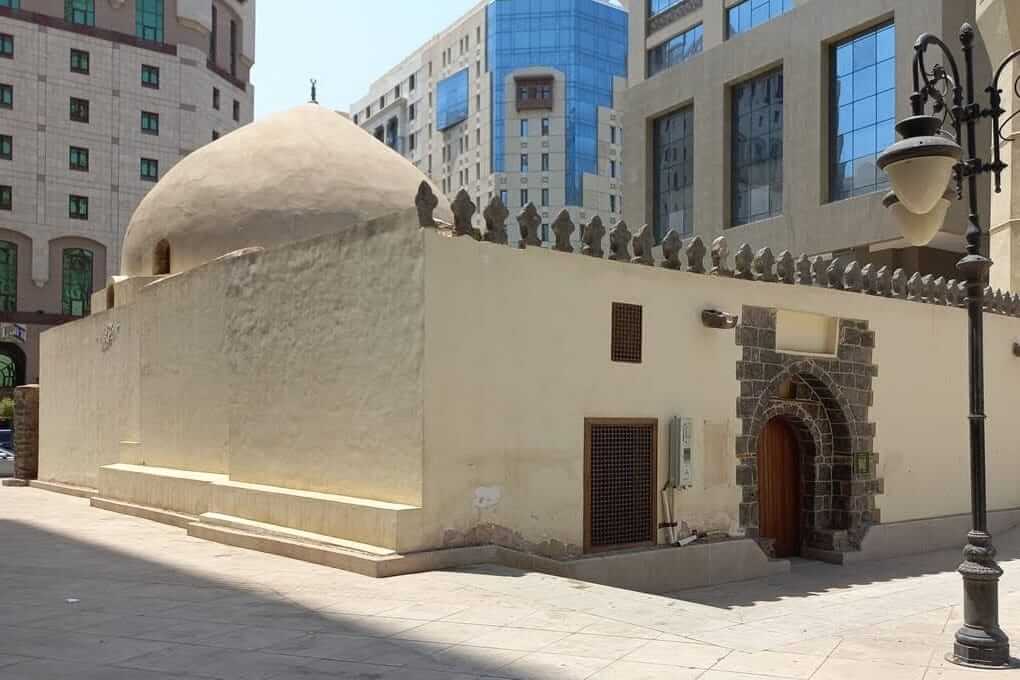
Masjid Umar ibn al-Khattab is one of the historically significant mosques of Madinah, quietly preserving the legacy of the second Rightly Guided Caliph, Umar ibn al-Khattab (RA). Though modest in size, its importance lies in its strong connection to the Prophet Muhammad ﷺ, the early Islamic prayer grounds of Madinah, and the leadership era of one of Islam’s most influential companions.
Located very close to Al-Masjid an-Nabawi, this mosque is commonly visited as part of a short walking ziyarat that includes Masjid al-Ghamamah and Masjid Abu Bakr. For pilgrims who wish to understand Madinah beyond the Prophet’s Mosque, Masjid Umar ibn al-Khattab offers a meaningful historical pause rooted in authentic Islamic tradition.
Who Was Umar ibn al-Khattab (RA) and Why This Mosque Matters
Umar ibn al-Khattab (RA), known as Al-Farooq, was the second Caliph of Islam and one of the closest companions of the Prophet ﷺ. His leadership shaped the political, judicial, and spiritual foundations of the Muslim Ummah. A mosque bearing his name in Madinah is not merely symbolic; it reflects his direct role in organizing public worship and preserving the Sunnah practices established by the Prophet ﷺ.
This mosque commemorates Umar’s association with the open prayer grounds where Eid and rain-seeking prayers were conducted during the Prophet’s time and formalized during Umar’s caliphate.
Historical Significance of Masjid Umar ibn al-Khattab
Connection to the Prophet’s Eid and Istisqa’ Prayers
Before Masjid an-Nabawi expanded to its current scale, the Prophet Muhammad ﷺ would perform Eid prayers and Salat al-Istisqa’ (prayer for rain) in an open area west of the mosque. This practice emphasized humility, unity, and accessibility for the entire community.
The location of Masjid Umar ibn al-Khattab is directly linked to that historic prayer ground. While the Prophet ﷺ led prayers there during his lifetime, Umar ibn al-Khattab (RA) later designated specific areas for organized Eid prayers, ensuring continuity of prophetic practice.
Development During the Caliphate of Umar ibn al-Khattab
Although the mosque structure itself was constructed later—historically dated to after 850 AH—the site gained its identity from Umar’s leadership role in prayer and governance. Over centuries, Muslim rulers preserved this location by marking it with a mosque, transforming an open prayer area into a lasting place of remembrance.
Location of Masjid Umar ibn al-Khattab in Madinah
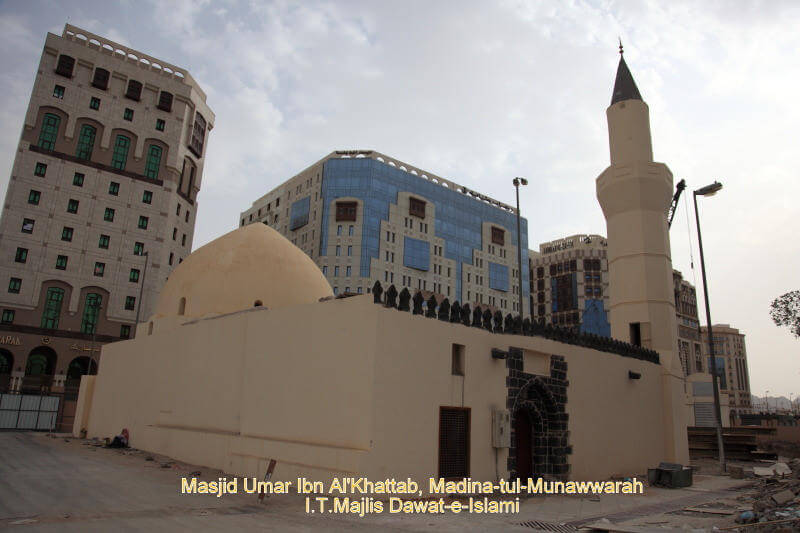
Masjid Umar ibn al-Khattab near Masjid an-Nabawi
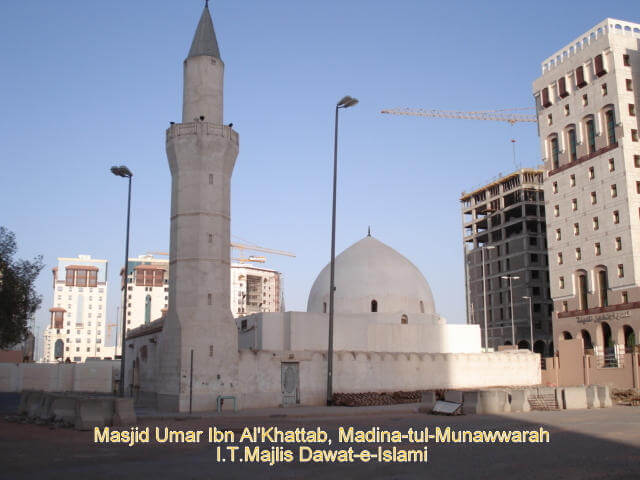
The most commonly visited Masjid Umar ibn al-Khattab is located in the Al-Manakhah area, approximately 133 meters from the courtyard of Al-Masjid an-Nabawi. It stands adjacent to Masjid al-Ghamamah and close to Masjid Abu Bakr, forming a historically connected cluster of mosques.
Its proximity makes it easily accessible on foot, especially for pilgrims staying near the Prophet’s Mosque.
Masjid Umar ibn al-Khattab in the Seven Mosques (Khandaq) Area
Another mosque bearing the same name exists in the Seven Mosques (Sab‘ah Masajid) area near Jabal Sala’, around 3–4 kilometers from Masjid an-Nabawi. This site is associated with Umar ibn al-Khattab’s role during the Battle of the Trench (Khandaq), where he is believed to have supervised defensive positions.
This mosque is often viewed from outside and included as part of guided Khandaq ziyarat tours.
Architecture and Physical Features
The Masjid Umar ibn al-Khattab near Al-Ghamamah reflects traditional Madinan mosque architecture. Built primarily from dark basalt stone, it features a simple square prayer hall, a white interior, and a single prominent dome. A modest minaret rises to approximately 15 meters, maintaining harmony with the surrounding historic mosques.
The design is intentionally minimal, encouraging reflection rather than extended congregation, in keeping with its role as a ziyarat mosque.
Visiting Masjid Umar ibn al-Khattab – What to Expect
Best Time to Visit
The mosque is usually visited during daytime hours as part of a walking ziyarat route. While it may be open for prayers at certain times, visitors should be aware that it is occasionally closed, in which case viewing from the outside remains meaningful.
Prayer Access and Visitor Etiquette
If the mosque is open and the prayer time is permissible, visitors may pray two rak‘ahs and make du‘a. The intention should remain focused on remembering Allah and honoring the legacy of Umar ibn al-Khattab (RA), not seeking special reward tied to the location itself.
Maintaining calm behavior, modest dress, and respect for surrounding pathways reflects the adab of Madinah.
Nearby Mosques and Ziyarat Route
Masjid Umar ibn al-Khattab is best visited alongside Masjid al-Ghamamah and Masjid Abu Bakr, all within a few minutes’ walk from the western side of Masjid an-Nabawi. This short ziyarat provides a deep understanding of early Islamic public worship spaces without requiring extensive travel.
How to Reach Masjid Umar ibn al-Khattab Easily
Pilgrims staying near Masjid an-Nabawi can reach the mosque on foot. For those planning to include it within a broader Madinah ziyarat—such as Quba Mosque, Masjid Qiblatain, and the Seven Mosques—reliable transportation becomes essential.
Our Umrah and Madinah taxi services offer comfortable, air-conditioned vehicles with experienced local drivers who understand ziyarat routes and prayer timings. Whether you are traveling individually, with family, or in a group, arranging a dedicated Madinah ziyarat taxi ensures you can visit historic sites like Masjid Umar ibn al-Khattab with ease and peace of mind.
Including This Mosque in Your Umrah and Madinah Ziyarat Journey
Masjid Umar ibn al-Khattab is not a place for lengthy stays, but it plays a vital role in understanding the spiritual geography of Madinah. Including it in your ziyarat adds historical depth to your Umrah journey and strengthens your connection to the Sahabah who shaped Islamic civilization.
Combining walking visits near Masjid an-Nabawi with guided or private taxi tours to farther sites allows pilgrims to experience Madinah in a balanced and organized way.
FAQs
What is the history of Masjid Umar ibn al-Khattab?
It marks a site associated with the Prophet’s Eid prayers and Umar ibn al-Khattab’s leadership in organizing public worship, later preserved by building a mosque.
Is Masjid Umar ibn al-Khattab close to Masjid an-Nabawi?
Yes, it is located about 133 meters from the Prophet’s Mosque, near Masjid al-Ghamamah.
Is there more than one mosque with this name in Madinah?
Yes, one is near Masjid an-Nabawi, and another is in the Seven Mosques area near Jabal Sala’.
Is there a dress code for visiting the mosque?
Standard Islamic modest dress applies, as with all mosques in Madinah.
Conclusion
Masjid Umar ibn al-Khattab stands as a quiet yet powerful reminder of Madinah’s early Islamic history, linking the Prophet Muhammad ﷺ, the practice of communal prayer, and the legacy of Umar ibn al-Khattab (RA). Though small in structure, its spiritual and historical significance makes it a valuable ziyarat stop for pilgrims seeking a deeper understanding of the city of the Prophet.
By including this mosque in your Madinah itinerary—whether on foot or through a well-planned ziyarat taxi service—you enrich your Umrah journey with authentic moments of reflection, remembrance, and connection to the foundations of Islam.

Zeeshan is a professional driver and tour guide who has been living and driving in Saudi Arabia for the past 5 years. With deep knowledge of the roads, landmarks, and Ziyarat locations across Makkah, Madinah, Jeddah, and Taif, he helps pilgrims and travelers enjoy safe, smooth, and well-organized journeys. His experience in Umrah transport, city tours, and airport transfers makes him a trusted expert for visitors exploring Saudi Arabia.