



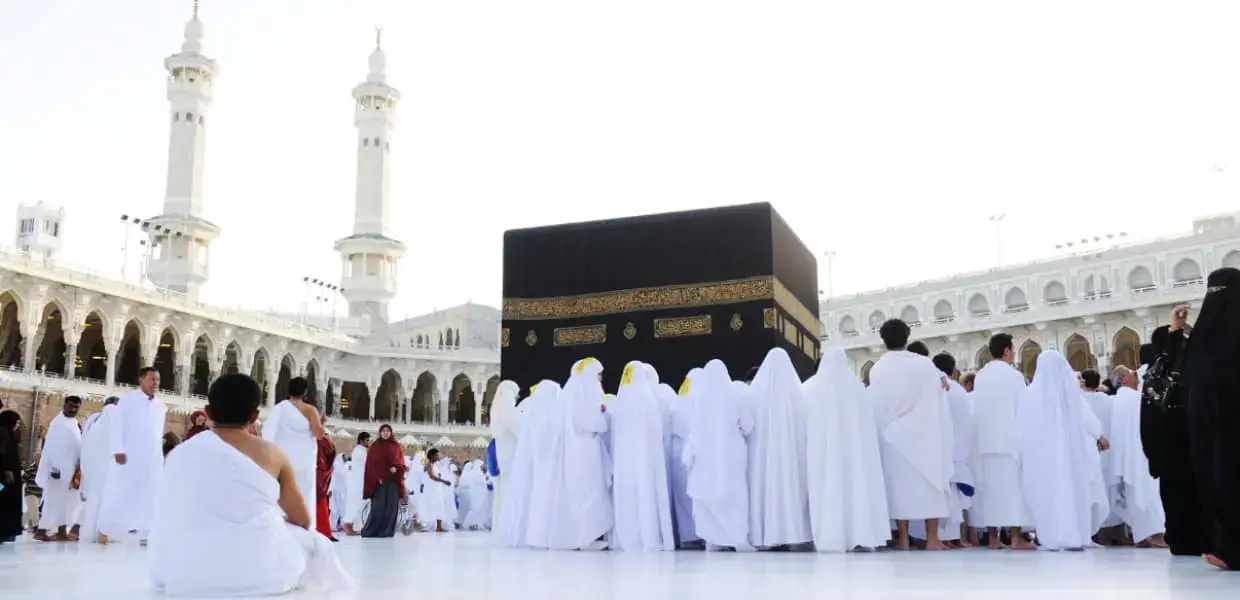
Talbiyyah is one of the most profound and defining acts of worship performed during Hajj and Umrah. It is a sacred chant proclaimed by pilgrims after entering the state of Ihram, symbolizing a believer’s complete submission, presence, and response to the call of Allah. Through Talbiyyah, the pilgrim verbally affirms Tawhid (the Oneness of Allah), devotion, humility, and readiness to obey.
More than a verbal ritual, Talbiyyah is a continuous spiritual state that accompanies the pilgrim throughout the sacred journey until specific rites are completed.
What Is Talbiyyah in Islam?
Linguistically, Talbiyyah comes from the Arabic root “labbayka”, meaning to respond repeatedly and willingly. In Islamic worship, it represents answering Allah’s invitation to His Sacred House.
Religiously, Talbiyyah is the pilgrim’s declaration of:
- Absolute obedience to Allah
- Rejection of all forms of association (shirk)
- Recognition that all praise, blessings, and dominion belong solely to Allah
It transforms the pilgrim’s journey into an act of conscious servitude rather than mere physical travel.
Recommended: Masjid Al-Haram
Arabic Text, Transliteration, and Meaning of Talbiyyah
The Core Sunnah Text
Arabic:
لَبَّيْكَ ٱللَّٰهُمَّ لَبَّيْكَ، لَبَّيْكَ لَا شَرِيكَ لَكَ لَبَّيْكَ، إِنَّ ٱلْحَمْدَ وَٱلنِّعْمَةَ لَكَ وَٱلْمُلْكَ، لَا شَرِيكَ لَكَ
Transliteration:
Labbayka Allāhumma labbayk, labbayka lā sharīka laka labbayk, inna al-ḥamda wa an-ni‘mata laka wa al-mulk, lā sharīka lak.
Meaning:
“Here I am at Your service, O Allah, here I am. Here I am, You have no partner, here I am. Truly all praise, all blessings, and all sovereignty belong to You. You have no partner.”
This wording is agreed upon across Sunni schools, with authentic narrations allowing additional phrases of praise without altering the core declaration of Tawhid.
Purpose and Spiritual Significance of Talbiyyah
Talbiyyah serves multiple spiritual purposes:
- Affirmation of Tawhid: A clear rejection of all partners besides Allah
- Spiritual Presence: Training the heart to remain conscious of Allah throughout the pilgrimage
- Humility and Obedience: Acknowledging that the pilgrim owns nothing—not even their journey
- Unity of the Ummah: Millions reciting the same words across languages and cultures
Spiritually, Talbiyyah removes worldly distractions and centers the pilgrim’s intention purely on Allah.
Recommended: What Was Inside the Kaaba?
When Talbiyyah Is Recited During Hajj and Umrah
Beginning of Talbiyyah
Talbiyyah begins immediately after making the intention and entering Ihram for either Hajj or Umrah.
End of Talbiyyah for Hajj
For Hajj pilgrims, Talbiyyah continues until:
- The stoning of Jamrah al-‘Aqabah on the 10th of Dhul Hijjah
- Or just before Tawaf al-Ziyarah, if performed first
End of Talbiyyah for Umrah
For Umrah pilgrims, Talbiyyah stops just before starting the Tawaf of Umrah.
Method and Etiquette of Reciting Talbiyyah
Sunnah Method
The Sunnah method includes brief pauses at key points:
Labbayka Allāhumma labbayk —
labbayka lā sharīka laka labbayk —
inna al-ḥamda wa an-ni‘mata —
laka wa al-mulk —
lā sharīka lak.
Voice Etiquette
- Men: Raise the voice audibly
- Women: Recite softly without raising the voice
After the First Talbiyyah
It is recommended to:
- Send Salawat upon the Prophet ﷺ
- Make personal du‘a for oneself and others
Repetition
Talbiyyah is preferably repeated three times or more whenever recited.
Situations in Which Talbiyyah Is Recommended
Talbiyyah should be recited abundantly in all states, including:
- Standing, walking, sitting, or lying down
- Traveling by vehicle
- States of minor or major impurity
- During menstruation
It is especially recommended when:
- Day or night begins
- Boarding or leaving a vehicle
- After prayers
- Entering a mosque
- Encountering groups of pilgrims
This constant remembrance reinforces spiritual awareness.
When Talbiyyah Should Not Be Recited
Talbiyyah should not be recited during:
- Tawaf
- Sa’i
During these rites, specific supplications and remembrances take precedence.
Legal Status of Talbiyyah According to Islamic Schools
- Hanafi & Maliki: Talbiyyah is wajib; neglecting it invalidates Hajj or Umrah
- Shafi‘i & Hanbali: Talbiyyah is sunnah; leaving it does not invalidate the pilgrimage
Despite juristic differences, all schools agree on its immense virtue and emphasis.
Talbiyyah in Hadith and the Unseen Response
The Prophet Muhammad ﷺ said that whenever a Muslim recites Talbiyyah, everything to their right and left—stones, trees, and earth—responds with Talbiyyah, until the ends of the land.
This hadith highlights:
- The cosmic nature of worship
- The unseen participation of creation
- The honor granted to the pilgrim
Talbiyyah is not uttered in isolation; it resonates throughout Allah’s creation.
FAQs
What does Talbiyyah mean in simple words?
It means responding to Allah’s call with complete obedience and devotion.
Can Talbiyyah be recited in any condition?
Yes, it can be recited in all physical states, including impurity or menstruation.
Is Talbiyyah only for Hajj?
No, it is recited during both Hajj and Umrah.
Do women recite Talbiyyah aloud?
Women recite it softly, unlike men who raise their voices.
Final Note
Talbiyyah is the living heartbeat of Hajj and Umrah—an act that unites belief, intention, voice, and soul. Understanding its meaning, timing, and rulings transforms the pilgrimage from a physical journey into a deeply conscious act of worship, aligning the pilgrim with the purpose of servitude to Allah alone.

Zeeshan is a professional driver and tour guide who has been living and driving in Saudi Arabia for the past 5 years. With deep knowledge of the roads, landmarks, and Ziyarat locations across Makkah, Madinah, Jeddah, and Taif, he helps pilgrims and travelers enjoy safe, smooth, and well-organized journeys. His experience in Umrah transport, city tours, and airport transfers makes him a trusted expert for visitors exploring Saudi Arabia.